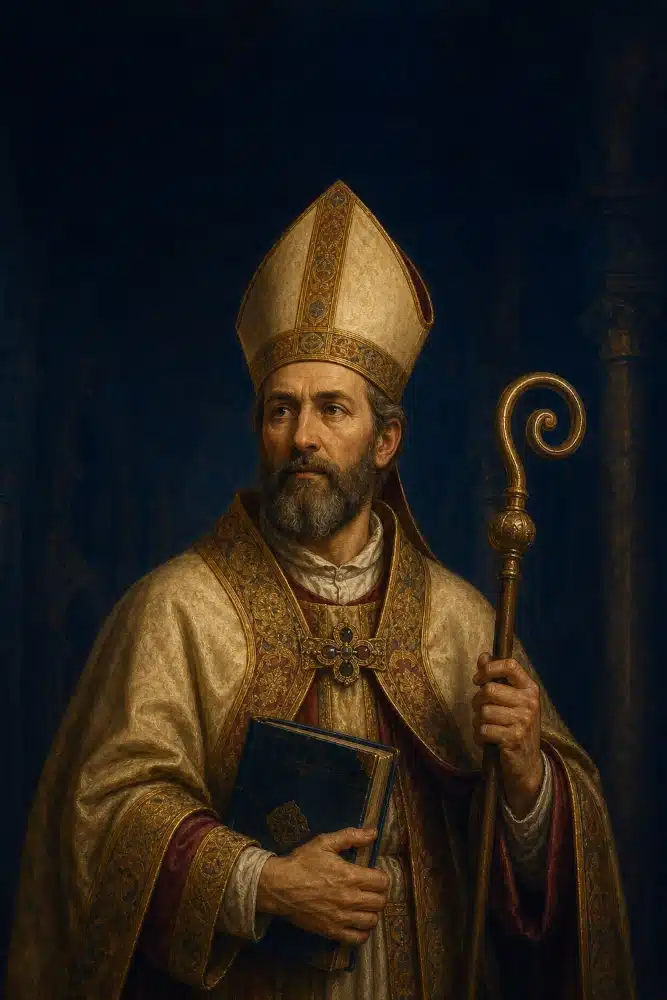
St. Ambrose did not plan to become a bishop. When the Christians of Milan called him to lead the Church in 374, he was serving as a Roman governor and had not yet been baptized.
01
From Roman governor to Bishop of Milan
Ambrose was born around 340 into a Christian Roman family. Educated in Rome for public life, he studied law, literature, and rhetoric before entering imperial service. He eventually became governor of Liguria and Emilia, with his headquarters in Milan.
When the Arian bishop Auxentius died, religious conflict threatened the city. Ambrose entered the church where the episcopal election was taking place and appealed for peace. According to his early biographer, a voice cried out, “Ambrose, bishop!” The crowd took up the call.
Ambrose resisted. He was a catechumen, not a priest, and had not trained for ordained ministry. Yet the demand persisted. He received baptism, passed rapidly through the required orders, and was consecrated Bishop of Milan on December 7, 374.
02
Defender of the Nicene faith
At the heart of the Arian controversy was a fundamental question: Who is Jesus Christ? The Nicene faith professed that the Son is truly God and consubstantial with the Father. Arian teaching denied the Son’s full and eternal divinity.
The conflict became concrete when imperial authorities sought basilicas in Milan for Arian worship. Ambrose refused to surrender the churches entrusted to him. His stand expressed a lasting principle: civil authority is real, but political power does not determine the Church’s doctrine.
Peace could not be purchased by surrendering the truth about Christ.
03
The preacher who reached St. Augustine
Augustine arrived in Milan as an accomplished teacher of rhetoric who had wrestled for years with philosophical and religious questions. At first he listened to Ambrose because of the bishop’s reputation for eloquence. In time, he began to hear the substance as well as the style.
Ambrose’s interpretation of Scripture showed Augustine that some of his objections rested on misunderstandings. Ambrose was not the only influence on his conversion. Scripture, philosophy, personal struggle, prayer, and the faithful witness of St. Monica all mattered. Still, the bishop played a decisive pastoral and intellectual role.
During the Easter Vigil on April 24, 387, Ambrose baptized St. Augustine of Hippo in Milan. The searching professor would become Bishop of Hippo and one of Christianity’s most influential theologians.
04
What Catholics can learn from St. Ambrose
God may interrupt our plans
Ambrose prepared for public service, yet God used that formation when the Church unexpectedly called him.
Courage serves the truth
He valued peace, but would not purchase it by surrendering the truth about Jesus Christ.
Leaders must keep learning
Made bishop without formal theological training, Ambrose responded with humility and disciplined study.
Preaching can open a door
His careful teaching helped Augustine see that Christianity was deeper than he had assumed.
Ambrose also gave away much of his wealth and taught that Christian belief must bear fruit in justice and generosity. His defense of doctrine and his care for the poor belonged to one faith.
Ambrose did not choose the circumstances that made him bishop. He chose how faithfully he would respond.
05
Words from St. Ambrose
Ambrose wrote as a bishop, pastor, biblical teacher, and defender of the faith. These brief passages reveal his humility, his confidence in Christ, and his concern for the Christian life.
From his writings
Translation wording can vary between editions. Citations identify the work or authoritative source for each quotation.
“I began to teach before I began to learn.”
“The foundation is Christ.”
“It is not property which makes rich, but the spirit.”
“Hold on to the tiller of faith so that the rough winds of this world may not bandy you.”
“Omnia Christus est nobis!”
“Drink Christ, for he is the rock that pours forth a flood of water.”
06
Common questions
What is St. Ambrose best known for?
He is known as Bishop of Milan, a Doctor of the Church, a defender of the Nicene faith, a major Latin preacher, and an important influence on St. Augustine.
Was Ambrose baptized when chosen as bishop?
No. He was still a catechumen. He received baptism and passed rapidly through the required orders before his consecration on December 7, 374.
What was his relationship with St. Augustine?
Ambrose’s preaching helped Augustine overcome intellectual objections to Christianity. Ambrose baptized him in Milan during the Easter Vigil on April 24, 387.
Did St. Ambrose write the Te Deum?
A later tradition links Ambrose and Augustine with the hymn, but historians do not consider the story reliable. Ambrose’s genuine contribution to Latin hymnody remains significant.
Editorial sources