The Nicene Creed is not just an old church formula people recite and move past. It is the Church’s hard-won confession that Jesus Christ is truly God, that the Holy Spirit is truly divine, and that salvation rests on the life of the Holy Trinity. It was forged in controversy, clarified by councils, and preserved because the early Church knew exactly what was at stake.
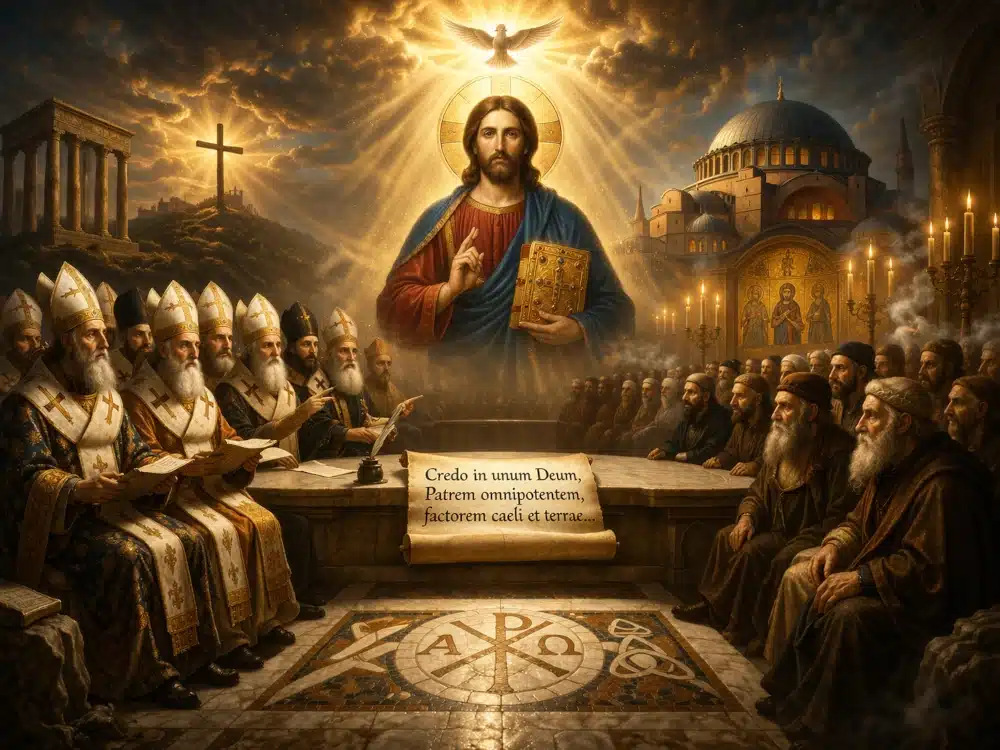
The Nicene Creed is commonly linked to the Council of Nicaea, but the text Christians recite today reflects the doctrinal work of two councils: Nicaea in AD 325 and Constantinople in AD 381. Nicaea established the Church’s decisive rejection of Arianism and confessed that the Son is of the same substance as the Father. Constantinople later gave fuller expression to the creed’s language, especially in what it says about the Holy Spirit.
As one of the Church’s clearest summaries of what Catholics believe, the Creed places its teaching about Christ within the larger Catholic confession of the Father, the Son, the Holy Spirit, the Church, Baptism, resurrection, and eternal life.
This was a turning point in Christian history. In AD 324, Constantine had reunited the Roman Empire, and after ending imperial persecution of Christians in AD 313, he convened the first ecumenical council to address a controversy that was tearing the Church apart. That matters. Constantine created the setting for the bishops to meet, but he did not dictate doctrine. The creed was hammered out by bishops wrestling with Scripture, liturgical worship, and apostolic faith already handed down in the Church.
This is also where the Nicene Creed differs from the Apostles’ Creed in tone and precision. The Apostles’ Creed is ancient, concise, and deeply valuable, but the Nicene Creed adds sharper language where the crisis required sharper clarity. It spells out the divinity of Christ and later gives a more developed confession of the divinity of the Holy Spirit, because those truths had to be defended publicly and unmistakably.
Back to topThe immediate controversy behind the Nicene Creed was Arianism. Around AD 318, the Alexandrian presbyter Arius began teaching that the Son was not eternal in the same way as the Father. In his view, Jesus was the highest of creatures,a celestial servant through whom God made the world,but still made, still subordinate, still not true God in the fullest sense.
Arius tried to reason from ideas about God’s absolute transcendence and immutability. The Father, he thought, is timelessly self-subsistent,something later theology can discuss with terms like autotheos,while the Son, because He suffers, grows, obeys, and dies in the Gospel accounts, must be something less than the Father. Arius believed he was protecting monotheism. But in practice, he created a disaster. If the Son is less than true God, then Christians are worshiping a creature. And if the Son is merely a creature, then the one mediating salvation does not fully bring us into the life of God.
Arius was opposed by Bishop Alexander of Alexandria and, even more famously, by Athanasius. Their central argument was direct: if God is eternally Father, then He must have an eternal Son. The Father does not become Father only when a creature appears. The Son is not an add-on. He is eternally begotten, not temporally manufactured.
Scripture presses in the same direction. St. John opens his Gospel with the words "In the beginning was the Word, and the Word was with God, and the Word was God" (John 1:1). Jesus also speaks and acts in ways that scandalize His opponents precisely because He makes Himself equal with God, as in John 5:16-18. He says, "I and the Father are one." (John 10:30), and in John 14:6-14 He reveals Himself as the way to the Father in terms far beyond what any mere creature could claim.
Back to topAt the structural level, the Nicene Creed is organized in three articles: one on the Father, one on the Son, and one on the Holy Spirit. That basic pattern parallels the Apostles’ Creed, but the Nicene Creed expands where controversy demanded precision. It is not a random list of theological slogans. It is a carefully ordered confession of the Trinity and the economy of salvation.
The creed begins with the Father as the almighty Creator of heaven and earth, of all things visible and invisible. That opening guards monotheism from the start. Christian faith is not belief in competing gods, but in one God.
The longest section is on Jesus Christ. That is not accidental. The Church had to say more because error had said more. The creed expands Christ’s identity, incarnation, crucifixion under Pontius Pilate, resurrection, ascension, and future return.
The Holy Spirit section is brief in the 325 form and fuller in the later Constantinopolitan form. That expansion matters because it openly confesses the Spirit as divine and worthy of the same worship and glory as the Father and the Son.
The creed clearly says Christ came down for us and for our salvation, but it does not lock itself into one later atonement theory. It stays rooted in the saving events themselves,incarnation, Cross, resurrection, ascension, and future judgment.
Key Nicene language:
“God from God, Light from Light, true God from true God, begotten, not made, consubstantial with the Father.”
This is the beating heart of the creed. The Son is called the only-begotten Son, begotten of the Father before all ages. That wording protects two truths at once. First, the Son is truly from the Father. Second, this begetting is not an event in time like creaturely origins. The Son is eternally from the Father. He does not begin to exist.
The phrase “begotten, not made” is one of the creed’s cleanest blows against Arianism. Arius could tolerate lofty titles for Christ as long as Christ remained created. Nicaea refused that ambiguity. The Son is not made. He does not belong on the creature side of the line. He belongs fully on the divine side.
Then comes the famous word homoousios, often translated one substance or consubstantial. That word says the Son shares the very being of the Father. Not similar substance. Not near-divinity. Not “almost God.” The same divine reality.
The old sun-and-ray analogy can help, if used carefully. A ray is not something foreign to the sun. It is from the sun and of the sun. In a limited way, that image helps Christians see how the Son is from the Father without being less divine. Every analogy limps a little. But it still gets closer than the Arian idea of the Son as a glorious created assistant.
Back to topIn the original 325 form, the article on the Holy Spirit was brief. By the time of Constantinople in AD 381, the Church expanded that section because questions about the Spirit’s divinity had become more pressing. The fuller form says: “I believe in the Holy Spirit, the Lord, the giver of life, who proceeds from the Father, who with the Father and the Son together is worshiped and glorified, who has spoken through the prophets.”
That language is massive. The Spirit is called Lord, not a force. The Spirit is the giver of life, not a created energy. The Spirit is worshiped and glorified together with the Father and the Son, which means the Spirit belongs fully within the divine life.
This also shows how deeply Trinitarian the creed really is. It is not satisfied with saying Christians believe in God in a vague sense. It names the Father, the Son, and the Holy Spirit distinctly while preserving monotheism. That is the grammar of Christian faith.
And pastorally, this matters too. The Holy Spirit is not an optional add-on to Christian life. The Spirit animates the Church’s worship, sanctifies believers, speaks through the prophets, strengthens sacramental life, and prepares the faithful for the resurrection of the dead and the life of the world to come.
Back to topChristianity is firmly monotheistic. The creed begins here on purpose. Everything that follows about the Father, Son, and Holy Spirit is a confession of the one God, not three competing divine beings.
God is not part of creation. He is its source. The Father is named first not because He is more divine than the Son or Spirit, but because the creed follows the revealed order of Trinitarian confession.
God created the seen world and the unseen. Matter is not evil. The spiritual world is not beyond His authority. This line quietly opposes dualistic errors that treat creation as a mistake.
Jesus is not merely a moral teacher or honored prophet. He is Lord. That title carries divine weight in Christian worship and places Christ at the center of the Church’s confession.
Sonship here is not symbolic only. It names a real and eternal relation to the Father. Jesus is Son by nature, not by adoption.
This is not a statement about Bethlehem. It refers to the Son’s eternal origin from the Father. Before creation, before time, before anything made,the Son already is.
This triple rhythm leaves very little wiggle room. Jesus is not a secondary deity or spiritual middle manager. He is fully and truly God.
Here the creed draws a hard line against Arius. The Son does not belong to the order of created things. He is from the Father, but not as a creature is from a creator.
This is the Church’s famous homoousios. The Son shares the same divine being as the Father. This is one of the most important anti-Arian lines ever written.
The Son is not a product of creation. He is on the Creator side of reality. Everything made comes through Him.
This is not abstract theology. The creed moves from eternal identity to saving mission. Christ comes for us, not merely to impress us or instruct us from a distance.
The incarnation is real. The eternal Son truly took on human nature. He did not merely appear human. He became man for our salvation.
The creed anchors salvation in history. This happened in the real world, under a real Roman governor. Christianity is not built on mythic symbolism floating above time.
Christ’s death was not pretend. His burial confirms the reality of His suffering and death. The one who died for us is the same divine Son confessed above.
The resurrection is the vindication of Christ’s identity and the beginning of new creation. The creed also reminds us that Easter fulfills the scriptural pattern, not a random divine improvisation.
The risen Christ reigns. His saving work is not over in the sense of becoming irrelevant now. He lives, intercedes, and reigns in glory.
Christian faith is future-facing. The creed does not end in nostalgia. It points toward judgment, justice, and the full unveiling of Christ’s kingship.
Earthly empires rise and fall. Christ’s kingdom does not. That line mattered in the fourth century, and it still matters now.
The Spirit is divine, living, personal, and active. The creed does not let us reduce the Spirit to vague inspiration or religious atmosphere.
This speaks of the Spirit’s eternal relation within the Trinity. The shared point remains clear: the Spirit is not created.
Worship settles doctrine again. The Spirit receives the worship due to God because the Spirit is God.
The Spirit is active across salvation history. The God confessed by the Church is the same God who spoke in Israel and fulfilled His promises in Christ.
The creed moves from God to the people God gathers. The Church is not an afterthought. She is the community shaped by apostolic faith and sacramental life.
The creed is doctrinal, but it is also sacramental. Faith is not only believed. It is confessed, lived, and entered through baptism.
Christianity does not promise escape from embodiment forever. It promises resurrection. Salvation includes the body, not just the soul.
The creed ends in hope. Not vague optimism. Real hope rooted in the triune God, the incarnation, the Cross, the resurrection, and the final victory of Christ.
The Nicene Creed matters because it draws a bright line around minimum Christian belief without trying to say everything that can be said. It tells the Church who God is, who Christ is, and what Christians mean when they speak of salvation.
It matters liturgically because the creed is still recited week after week. The Church is not merely remembering a fourth-century debate. She is being formed by truth. The repetition is not dead ritual when it is understood. It is weekly doctrinal formation in worship form.
It matters doctrinally because the old errors never really disappear. Arianism comes back in new clothes all the time,Jesus as exalted teacher, Jesus as creature, Jesus as moral example with a little spiritual glow around Him, Jesus as less than the Father in being rather than distinct from the Father in person. The creed cuts through all of that.
It matters soteriologically because the early Church saw the connection clearly: only God saves. A creature cannot reconcile humanity to God from the inside out. A merely elevated being cannot heal, redeem, and conquer death in the full Christian sense. The Nicene Creed preserves orthodoxy because orthodoxy preserves the gospel.
Back to topWhen teaching the Nicene Creed, do not rush straight into abstract terminology. Start with the question the early Church was really answering: Who is Jesus? Then show why the answer affects everything. If Jesus is not truly God, Christian worship becomes idolatry and Christian salvation becomes uncertain. If the Holy Spirit is not truly divine, then the Church’s worship and sacramental life rest on less than God.
A helpful teaching move is to connect the creed’s lines to the life of the Mass. People hear these words weekly. Help them notice that the creed is not a break from worship. It is worship. It is the Church saying, out loud and together, who God is and what He has done.
This page is written as a catechetical overview grounded in the historic Christian understanding of the Nicene Creed, with close attention to the Council of Nicaea, the Council of Constantinople, Arianism, the role of Constantine, and the creed’s confession of the Trinity, the divinity of Christ, and the Holy Spirit.
It is designed to be faithful, readable, and useful for parish education, drawing from recognized historical reference works and official Catholic sources for the creed itself.
Lord Jesus Christ,
As I reflect on the words of the Nicene Creed, slow me down. Don’t let these be just familiar phrases I pass over. Let me hear them again,like the first time.
You are God from God, Light from Light. Not distant. Not abstract. But present. Living. Near.
Help me to see You clearly, not as I imagine You to be, but as You truly are.
You came down for us and for our salvation. For me. Into the mess, into the ordinary, into the real.
Let that truth land. Let it move something in me.
Holy Spirit, giver of life, open my heart to what I’ve just read. Teach me to believe it, not just say it.
Father, Son, and Holy Spirit, draw me deeper into Your life. Not just understanding, but trust.
And as I go forward, help me carry this creed not only on my lips, but in the way I live.
Amen.