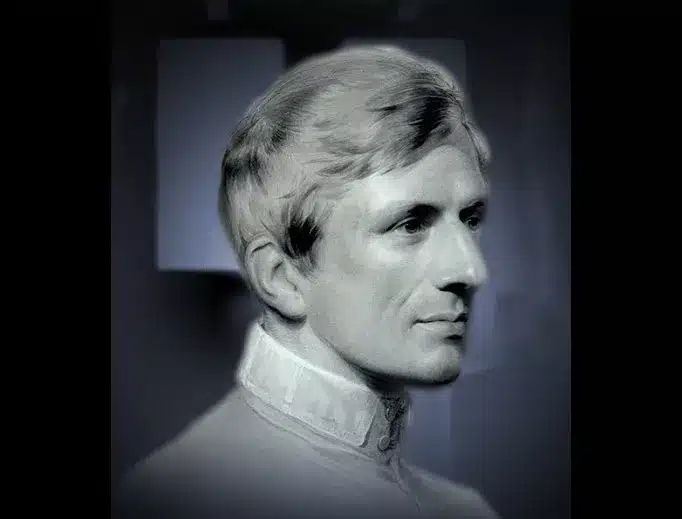
St. John Henry Newman
From Anglican Oxford to the Catholic Church, Newman followed truth through study, conscience, conversion, and a lifetime of service.
Early Life and Anglican Ministry
John Henry Newman was born in London on February 21, 1801. At age fifteen, he experienced a conversion that fixed his attention on God and the life of faith. He studied at Trinity College, Oxford, became a fellow of Oriel College, and was ordained an Anglican priest in 1825.
As vicar of the University Church of St. Mary the Virgin, Newman became one of Oxford’s most influential preachers. His Parochial and Plain Sermons examined faith, conscience, self-deception, holiness, and the hidden motives of the heart. Their quiet intensity revealed the pastoral concern that remained central throughout his life.
Newman initially held firmly to Anglicanism. Yet his study of Scripture, the creeds, and the Early Church Fathers made him increasingly concerned with apostolic authority and continuity. Those questions would soon place him at the center of the Oxford Movement.
“Holiness rather than peace.”John Henry Newman’s guiding principle, recalled by Pope Benedict XVI
The Oxford Movement
The Oxford Movement began in 1833 as an effort to recover the apostolic and sacramental character of the Church of England. Newman, John Keble, Edward Pusey, and their colleagues argued that Anglicanism should not be treated as a department of the state or merely as a product of the Reformation.
Newman became the movement’s leading writer through the Tracts for the Times. In Tract 90, published in 1841, he argued that the Thirty-Nine Articles could be interpreted in a Catholic sense. The tract provoked intense opposition and was condemned by Oxford authorities.
His historical studies were also changing his judgment. While examining controversies in the early Church, Newman became less convinced that Anglicanism occupied a stable middle position between Protestantism and Rome. He withdrew from public controversy and settled at Littlemore to pray, study, and discern.
Conversion to Catholicism
On October 9, 1845, the Passionist priest Blessed Dominic Barberi received Newman into the Catholic Church. The decision cost Newman his position, friendships, security, and public reputation. It was the conclusion of a long intellectual and spiritual journey rather than a sudden emotional turn.
Newman understood conscience as a summons to objective truth, not permission to invent private morality. Conscience binds because it bears witness to a law higher than the self. His conversion therefore expressed obedience to what he believed God had shown him through prayer, history, and reason.
His understanding fits the Catholic account of conscience and moral action. A conscience must be formed, must seek truth, and must accept correction. Sincerity alone does not guarantee that a judgment is right.
“Conscience is the aboriginal Vicar of Christ.”St. John Henry Newman, Letter to the Duke of Norfolk, Chapter 5
Conscience is not personal preference
Pope Benedict XVI explained that Newman saw conscience as the human capacity to recognize truth and the duty to obey it. This is the opposite of treating individual choice as the final authority in religion or morality.
Catholic Priest, Oratorian, and Cardinal
After becoming Catholic, Newman studied in Rome and was ordained a Catholic priest in 1847. He brought the Oratory of St. Philip Neri to England and established an Oratory in Birmingham, which became the center of his pastoral life.
His Catholic years included both accomplishment and disappointment. He faced suspicion from some Catholics who considered his ideas unfamiliar, while many former Anglicans distrusted his conversion. In 1864, a public accusation of dishonesty led him to write Apologia Pro Vita Sua, his spiritual autobiography. Its candid account restored much of his reputation.
Pope Leo XIII created Newman a cardinal in 1879. Newman chose the motto Cor ad cor loquitur, “Heart speaks to heart.” The phrase reflects his conviction that truth is communicated personally, through integrity, friendship, preaching, and witness as well as formal argument.
The Development of Christian Doctrine
Newman completed An Essay on the Development of Christian Doctrine as he approached reception into the Catholic Church. The book addresses how Christian teaching can become more explicit over time while remaining faithful to the apostolic deposit of faith.
Development is not the invention of a new religion. Newman compared authentic development with organic growth: a mature teaching must preserve the identity and essential principles present from the beginning. He proposed tests that help distinguish faithful development from corruption.
This work became especially influential in modern Catholic theology and contributed to later reflection surrounding the documents of the Second Vatican Council. Newman helps explain how the Church can respond to new questions without treating doctrine as either frozen language or unlimited change.
Faith, Reason, and the Illative Sense
In An Essay in Aid of a Grammar of Assent, Newman examined how people reach certainty in real life. Formal proofs matter, but many judgments depend on the convergence of numerous facts, experiences, probabilities, and insights. He called the mind’s personal act of bringing these strands together the illative sense.
This does not make faith irrational. Newman distinguished between understanding an idea and giving real assent to a truth. Religious belief engages the whole person because it concerns realities to be lived, loved, and obeyed.
His position provides an important Catholic response to the supposed conflict between faith and reason. Reason is broader than calculation alone, while faith does not ask the mind to abandon evidence. Both serve the search for truth.
Newman’s Vision of Education
Newman served as the first rector of the Catholic University of Ireland. Lectures connected with that work became The Idea of a University, one of the most influential modern statements on liberal education.
He argued that a university should cultivate the intellect, teach students to relate different fields of knowledge, and resist reducing education to immediate utility. Specialized training has value, but education also forms habits of judgment, clarity, and intellectual freedom.
Newman also insisted that theology belongs within a university that claims to pursue universal knowledge. Excluding questions about God does not create neutrality; it leaves the account of reality incomplete. His educational work explains why Pope Leo XIV named him co-patron of the Church’s educational mission alongside St. Thomas Aquinas.
Saint and Doctor of the Church
Newman died at the Birmingham Oratory on August 11, 1890. Pope Benedict XVI beatified him in Birmingham in 2010, and Pope Francis canonized him on October 13, 2019.
On November 1, 2025, Pope Leo XIV solemnly declared St. John Henry Newman a Doctor of the Universal Church during the Jubilee of the World of Education. This made Newman the 38th saint to receive the title. In 2026, his October 9 memorial was added to the General Roman Calendar.
The title recognizes the enduring value of his teaching for the whole Church. His work brings together historical study, doctrinal development, conscience, education, faith, reason, pastoral care, and holiness. His recognition places him with figures such as St. Augustine and St. Catherine of Siena.
“Life shines brightly…when we discover within ourselves the truth that we are called by God, have a vocation, have a mission.”Pope Leo XIV, homily at Newman’s proclamation as Doctor of the Church
Frequently Asked Questions About St. John Henry Newman
Who was St. John Henry Newman?
Newman was a nineteenth-century English theologian, writer, educator, Anglican convert, Catholic priest, cardinal, saint, and Doctor of the Church.
Why did Newman become Catholic?
His study of Church history, apostolic authority, and doctrinal development gradually convinced him that the Catholic Church preserved the fullness and visible continuity of the ancient Church.
What did Newman teach about conscience?
He taught that conscience is an interior witness to objective moral truth and a summons to obey God. He did not identify conscience with preference, feeling, or freedom from authority.
What is the development of doctrine?
It is the organic growth of the Church’s understanding and expression of revealed truth. Authentic development clarifies what was given in the apostolic faith without changing its essential identity.
When was Newman declared a Doctor of the Church?
Pope Leo XIV declared him a Doctor of the Universal Church on November 1, 2025. He is the 38th saint to receive the title.
What are Newman’s most important writings?
Major works include Apologia Pro Vita Sua, An Essay on the Development of Christian Doctrine, The Idea of a University, Grammar of Assent, and the Parochial and Plain Sermons.
Sources and Further Reading
- Pope Leo XIV: Proclamation of St. John Henry Newman as Doctor of the Church
- Dicastery for Divine Worship: Newman and the General Roman Calendar
- Pope Benedict XVI: Homily for Newman’s beatification
- Pope Francis: Homily for Newman’s canonization
- John Henry Newman: Apologia Pro Vita Sua
- John Henry Newman: An Essay on the Development of Christian Doctrine