Recognizing Who Is Present
Walking into a Catholic church can feel unfamiliar if you have never attended Mass before. Even lifelong Catholics sometimes have questions about proper Mass etiquette.
When should you genuflect? How early should you arrive? Can you eat before Mass? What should you wear? When should you kneel? What should you do if you cannot receive Holy Communion?
These practices can look like a long list of rules.
But Catholic Mass etiquette makes much more sense when we understand what is behind it.
Reverence is the point, not rule-following.
Catholics believe the Mass is sacred worship and that Jesus Christ is truly present in the Eucharist. The Church calls the Eucharist the "source and summit of the Christian life."
That belief shapes how Catholics prepare for Mass, behave inside the church, participate in the liturgy, and approach Holy Communion.
Source: Catechism, 1324.
Catholic Mass Etiquette at a Glance
| Before Mass | During Mass | Communion | After Mass |
|---|---|---|---|
| Arrive early when possible | Participate attentively | Receive if properly disposed | Pray in thanksgiving |
| Prepare yourself in prayer | Listen to Scripture | Approach reverently | Remain through the dismissal |
| Silence your phone | Follow postures as able | Bow before receiving in the U.S. | Respect those still praying |
| Dress respectfully | Avoid unnecessary distractions | Respond “Amen” | Leave quietly |
| Observe the fast if receiving | Join prayers and responses | Consume the Host immediately | Live what you celebrated |
Mass Etiquette Is About Reverence, Not Perfection
There is an important distinction between learning proper Mass etiquette and watching everyone else to see whether they are following it.
The elderly person who remains seated may be unable to kneel.
The mother walking toward the vestibule may be trying to calm a crying child.
The visitor who does not genuflect may have entered a Catholic church for the first time.
The person who remains in the pew during Communion may be making a deeply reverent decision not to receive.
Someone arriving late may have encountered circumstances completely outside his or her control.
Mass etiquette should help us examine our own behavior, not everyone else's.
We should learn how to behave reverently while extending charity to the people worshiping beside us.
Before Mass
Arrive Early When Possible
Arriving a few minutes early gives you time to settle down and prepare for what is about to happen.
There is no universal Church rule requiring Catholics to arrive 10 or 15 minutes before Mass. It is simply a good practice.
Use those few minutes to find a seat, silence your phone, read the Scripture readings if you wish, and pray.
More importantly, allow yourself to become still.
You are transitioning from the ordinary activities of the day to the worship of God.
Silence Your Phone
Phones should normally be silenced before Mass begins.
A phone ringing during the Gospel, homily, or Eucharistic Prayer can distract you and the people around you.
There are legitimate reasons someone may need to remain reachable, especially parents, caregivers, medical professionals, and emergency personnel.
The principle is simple:
Avoid unnecessary distractions during worship.
That generally means Mass is not the time for texting, checking social media, reading email, or browsing the internet.
Using a phone to follow the readings or a digital missal is different, although it should still be done in a way that does not become a distraction.
What Should You Wear to Catholic Mass?
The Catholic Church does not prescribe a universal Sunday dress code.
A better principle is to dress with modesty, dignity, and respect appropriate for worship.
Customs vary among cultures, climates, parishes, and communities. A suit or formal dress is not required simply because you are attending Mass.
Wear something appropriate for worship.
Then extend charity to everyone else.
Someone may have come directly from work. A family may have struggled just to get several children out the door. A visitor may have had no idea what people normally wear to a Catholic church.
Dress reverently yourself without turning clothing into a way of measuring another person's faith.
Entering a Catholic Church
Blessing Yourself With Holy Water
Holy water is commonly found near the entrances of Catholic churches.
Catholics often dip their fingers into the water and make the Sign of the Cross:
In the name of the Father, and of the Son, and of the Holy Spirit. Amen.
The gesture recalls Baptism and our life in Christ.
It is a simple way to begin turning our attention toward God as we enter the church.
Should You Genuflect Before Sitting Down?
Catholics ordinarily genuflect toward the Blessed Sacrament when it is reserved in the tabernacle.
A genuflection is made by bringing the right knee to the ground.
There is an important distinction here.
Catholics do not simply genuflect because they are facing the front of the church. The genuflection is an act of reverence directed toward the Blessed Sacrament.
The altar is also reverenced, but ordinarily with a profound bow when the Blessed Sacrament is not present in the sanctuary.
This distinction tells us something important about Catholic worship.
We genuflect before the Blessed Sacrament because we believe Christ is truly present.
The Catechism teaches that Christ is present to His Church in many ways, but "most especially" in the Eucharistic species, where the whole Christ is truly, really, and substantially present.
Where Is the Tabernacle?
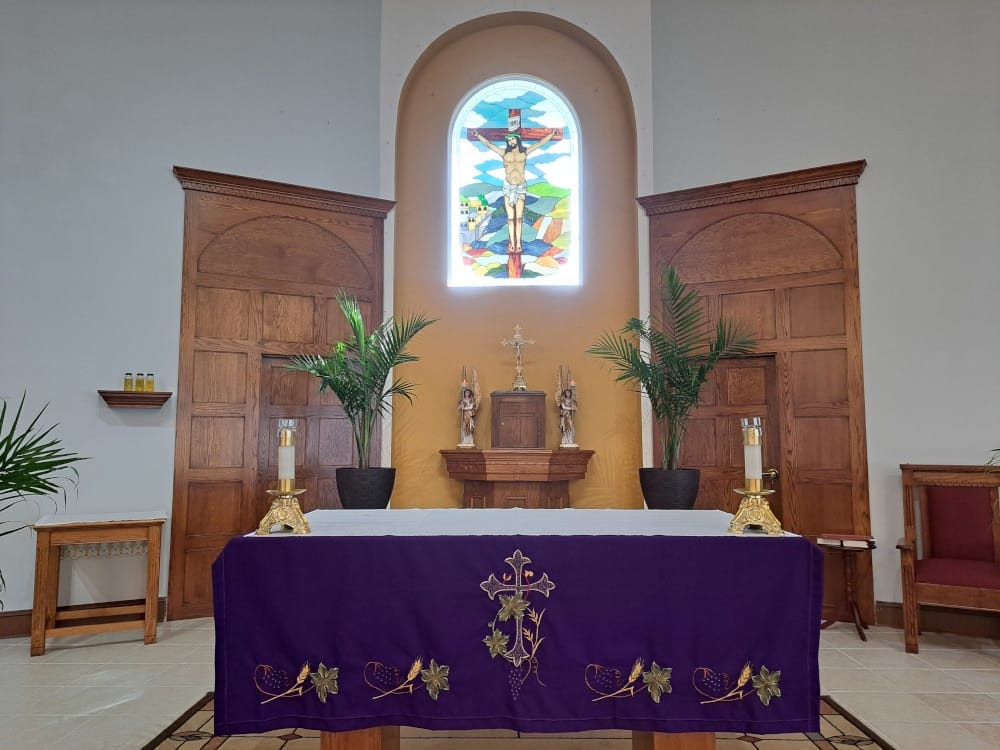
The tabernacle is the secure place where the consecrated Eucharist is reserved.
Its location varies. It may be behind the altar, elsewhere in the sanctuary, or in a separate chapel.
A sanctuary lamp near the tabernacle ordinarily indicates that the Blessed Sacrament is reserved there.
If you are visiting an unfamiliar church, don't worry about making a mistake. Look for the tabernacle and follow the congregation.
During Mass
Participate in the Mass
Catholic participation in Mass is more than simply being present in the building.
Listen to the Word of God.
Respond to the prayers.
Sing.
Pray.
Stand, sit, and kneel with the congregation.
And allow for silence.
Participation does not mean that something must be happening every second. Sacred silence is itself part of the liturgy.
Follow the Congregation's Postures
Catholic worship involves the body as well as the mind.
During Mass you will see people stand, sit, kneel, bow, make the Sign of the Cross, and perform other gestures.
These physical actions express prayer.
If you are visiting and don't know what to do, simply follow along as you are comfortable.
If age, disability, injury, pregnancy, or another physical condition makes standing or kneeling difficult, sit.
Reverence does not require hurting yourself.
Avoid Unnecessary Conversation
Conversation should be kept to a minimum during Mass.
The people around you are listening to Scripture, praying, preparing for Communion, or spending time with God.
Parish fellowship is important, but longer conversations can usually wait until after Mass.
Eating and Drinking During Mass
Except for legitimate needs, eating and drinking are generally inappropriate during Mass.
Young children and people with medical needs obviously require common sense.
Again, etiquette should not become an excuse to police the people sitting around you.
Source: GIRM, 42-45.
Holy Communion
This is where Catholic Mass etiquette becomes something much deeper than etiquette.
Catholics do not believe Communion is merely a symbol of belonging to the congregation.
We believe we receive Jesus Christ Himself.
The Church teaches that Christ's Body and Blood, together with His soul and divinity, are truly, really, and substantially present in the Eucharist.
That belief explains the extraordinary reverence Catholics show toward Holy Communion. Explore the Eucharist in Scripture to learn more about its biblical foundations.
Who Can Receive Holy Communion?
Catholics who are properly disposed are encouraged to receive Communion devoutly and frequently.
A Catholic preparing to receive should ordinarily:
- be in full communion with the Catholic Church
- not be conscious of unconfessed grave sin
- observe the Eucharistic fast
- approach Communion reverently
The U.S. bishops explain that a Catholic conscious of grave sin ordinarily should receive sacramental Confession before receiving Communion. A prayerful examination of conscience can help you prepare for Confession.
This is not because the Church wants to keep people away from Christ.
It is because Holy Communion really is communion.
Receiving the Eucharist expresses our communion with Christ and His Church.
Can Non-Catholics Receive Communion?
Non-Catholics are welcome to attend Catholic Mass.
Ordinarily, however, Holy Communion is received by Catholics who are properly disposed. The Church provides limited exceptions in particular circumstances under canon law.
A visitor who is not receiving Communion can simply remain in the pew and pray.
There is nothing embarrassing about doing so.
Catholics also remain in their pews when they are not receiving Communion.
What If I Am Catholic but Cannot Receive Communion?
Stay in your pew and pray.
You may also make a spiritual communion, expressing your desire for union with Christ even though you are not receiving Him sacramentally.
You do not have to receive Communion simply because everyone around you is walking forward.
Sometimes the most reverent decision is not to receive.
Source: Catechism, 1374.
How to Receive Holy Communion
The following sequence describes ordinary reception in the Roman Rite in the United States. Follow the legitimate norms of the place where you attend.
Approach
Join the procession prayerfully. In the United States, standing is the norm; an individual may receive kneeling.
Bow
Before receiving, bow your head as an act of reverence.
Say “Amen”
The minister says, “The Body of Christ.” Respond, “Amen,” affirming your faith.
Receive
Receive the Host on the tongue or, where permitted, in the hand. Both are permitted in the United States.
Consume immediately
If receiving in the hand, consume the Host immediately and entirely in the minister’s presence. Do not walk away carrying the Eucharist.
When the chalice is offered
The minister says, “The Blood of Christ.” Respond, “Amen,” and receive reverently. Do not dip the Host into the chalice yourself. Christ is received whole and entire under either species; receiving from the chalice is not required.
Source: GIRM, 160-162.
Source: USCCB, Norms for Holy Communion under Both Kinds, 41-46.
After Receiving Communion
Return to your place and pray.
This is a particularly important time for thanksgiving.
You have just received the Eucharist.
There is no need to immediately check the time, gather your belongings, or begin thinking about getting out of the parking lot.
Thank Christ.
Adore Him.
Speak to Him.
Listen.
The Communion Rite itself provides time for prayer and sacred silence after the faithful have received.
Join the Communion chant as appropriate. Personal thanksgiving belongs within the Church’s shared prayer, which also includes sacred silence.
Source: GIRM, 86-89.
Should You Leave Mass Immediately After Communion?
Ordinarily, no.
Mass does not end when you receive Communion.
The Communion Rite concludes with the Prayer after Communion, and Mass continues through the concluding rites and dismissal.
Unless there is a genuine reason to leave early, remain until Mass has concluded.
The dismissal reminds us that we are being sent.
We have worshiped God, heard His Word, and received the Eucharist. Now we are sent back into the world to live as disciples of Christ.
Source: GIRM, 90.
What If You Arrive Late to Mass?
Traffic happens.
Children have emergencies.
Alarm clocks fail.
Weather causes delays.
If you unexpectedly arrive late, enter quietly and join the Mass.
There is no universal Catholic rule saying that if you arrive a particular number of minutes late, "Mass doesn't count."
Catholics should make a sincere effort to participate in the entire Sunday Mass. Deliberately arriving late without good reason is different from being delayed by circumstances outside your control.
If you are late, don't turn around and go home.
Come in quietly and worship God.
Bringing Children to Mass
Children belong at Mass.
Babies cry. Toddlers wiggle. Children drop things.
Parents should make reasonable efforts to minimize serious disruptions, and sometimes stepping into a vestibule or cry room for a few minutes is helpful.
But ordinary sounds from children are part of parish life.
Catholics without young children should remember something important:
Those parents brought their children to Mass.
Children learn how to worship by worshiping with the Church.
A welcoming parish gives families room to do that.
Catholic Mass Etiquette for First-Time Visitors
If you have never attended Catholic Mass before, you are welcome.
You do not need to be Catholic to attend, and you don't need to memorize the prayers beforehand. If you would like to explore becoming Catholic, the parish can help you take the next step.
You can listen to Scripture, join in singing, pray, and follow the congregation when you are comfortable doing so.
You are not expected to perform gestures that contradict your own beliefs.
When people approach for Communion, you can remain in your pew.
And don't spend Mass worrying that everyone is watching you.
They shouldn't be.
They should be worshiping God.
What About Crossing Your Arms for a Blessing?
After Mass
After the dismissal, you may wish to remain for a few minutes of thanksgiving.
If others remain in prayer, respect their silence.
Then enjoy the life of the parish. You can also deepen your prayer through Eucharistic Adoration.
Introduce yourself. Talk with friends. Welcome visitors. Meet the priest. Get to know the people worshiping with you.
When possible, longer conversations are better moved to the vestibule, parish hall, or outside so those remaining in the church can continue praying.
Why Does Catholic Mass Etiquette Matter?
Why genuflect?
Why fast?
Why kneel?
Why prepare for Communion?
Why remain afterward and pray?
Because Catholics believe something extraordinary is happening.
The Mass is not simply a religious meeting, lecture, concert, or weekly gathering.
It is worship.
And at its center is Jesus Christ.
The Eucharist contains what the Catechism calls the whole spiritual good of the Church, Christ Himself.
Once we understand that, the practices surrounding the Mass begin to make sense.
We genuflect because we believe He is present.
We fast because we are preparing to receive Him.
We approach Communion reverently because it is His Body and Blood.
We pray afterward because we have received Him.
We participate because the Mass is our worship of God.
We remove distractions because something greater deserves our attention.
Catholic Mass etiquette therefore begins with something much greater than knowing where to put your phone or when to kneel.
It begins with recognizing Who is present.
Source: Catechism, 1324.
Frequently Asked Questions About Catholic Mass Etiquette
How early should I arrive for Catholic Mass?
There is no universal requirement to arrive a specific number of minutes early. Arriving 10 to 15 minutes beforehand is a helpful practice because it provides time to settle in and prepare for worship.
Can Catholics eat before Mass?
Yes. Catholics receiving Holy Communion ordinarily abstain from food and drink for at least one hour before receiving Communion, not before Mass begins. Water and medicine are excepted. Canon 919 also provides an exception for the elderly, the infirm, and those who care for them.
Does coffee break the Eucharistic fast?
Yes. Coffee is not included in the water and medicine exception. The fast is ordinarily measured from receiving Communion.
Does water break the Eucharistic fast?
No. Water and medicine do not break the Eucharistic fast.
Do Catholics have to genuflect when entering church?
Catholics ordinarily genuflect toward the Blessed Sacrament reserved in the tabernacle, if physically able. The gesture is not simply directed toward the front of the church. The altar is appropriately reverenced with a profound bow.
What should I wear to Mass?
Dress with modesty, dignity, and respect appropriate for worship. There is no universal Sunday dress code. Customs and circumstances vary; avoid judging another person by clothing.
What if I cannot kneel?
Remain seated or use a posture you can safely manage. Age, disability, injury, pregnancy, and other physical conditions can affect posture. Reverence does not require hurting yourself.
Can non-Catholics attend Mass?
Yes. You are welcome to listen, pray, and follow along as comfortable. Ordinarily non-Catholics do not receive Holy Communion, although Church law provides limited exceptions. Remaining in the pew and praying is appropriate.
Must I cross my arms to receive a blessing?
No. This is not a universal Catholic practice. Customs differ among parishes and dioceses. If you are not receiving Communion, remaining in your pew and praying is always appropriate.
What if I arrive late?
Enter quietly and join the Mass. Make a sincere effort to participate in the whole celebration. An unavoidable delay differs from deliberately arriving late without good reason.
Are babies and young children welcome?
Yes. Children belong at Mass. Parents can gently help them participate and step out briefly when needed. Fellow worshipers should offer patience and encouragement.
May I leave immediately after Communion?
Ordinarily, remain through the concluding rites and dismissal unless there is a genuine reason to leave early. Mass does not end when you receive Communion.
Authoritative Catholic References
- Catechism of the Catholic Church, 1324 and 1373-1381
The Eucharist at the center of Christian life and Christ’s Real Presence.
- Code of Canon Law, canons 916 and 919
Preparation for Communion, the one-hour fast, and its exceptions.
- General Instruction of the Roman Missal, 160-162 and 274-275
Receiving Communion in the United States, genuflection, and bows.
- General Instruction of the Roman Missal, 42-45, 86-90
Postures, sacred silence, Communion singing, and the concluding rites.
- USCCB, Guidelines for the Reception of Communion
Disposition, Christian visitors, and those who are not receiving.
- USCCB, Norms for Holy Communion under Both Kinds, 41-46
Reverent reception of the Host and from the chalice.
About This Catholic Guide
Prepared as a faith-education resource for San Isidro Catholic Church. This guide explains Catholic teaching through the Catechism, Code of Canon Law, General Instruction of the Roman Missal, and United States Conference of Catholic Bishops.
Practical directions refer primarily to the Roman Rite in the United States. Legitimate customs and norms can differ elsewhere. A parish priest can help with questions about your individual circumstances.
Reverence Is the Point
Love God. Respect what is sacred. Participate in the Mass. Receive Christ worthily. And show charity toward the people worshiping beside you.
↑ Back to Top