St. Anthony of Padua: From Lisbon to Doctor of the Church
A Franciscan preacher whose love for Scripture and care for the poor still call us to a life rooted in Christ.
Quick Catholic Answer
St. Anthony of Padua was a Portuguese Franciscan priest, preacher, and teacher, born around 1195. He died in 1231 and was declared a Doctor of the Church in 1946. Catholics honor him on June 13 and commonly ask his intercession for lost belongings. His life also teaches us to unite knowledge of the faith with prayer and service.
Key takeaways
- Anthony was born in Lisbon and became closely associated with Padua.
- His preaching placed Scripture and Christ at the center of Christian life.
- His care for the poor invites us to turn prayer into practical charity.
- Devotion to the saints leads us toward Jesus Christ.
Among the great figures of Catholic tradition, few saints capture the imagination and devotion of the faithful like St. Anthony of Padua. Known for his eloquence in preaching, his deep theological insight, and his tender compassion for the poor, St. Anthony’s life continues to inspire Catholics across centuries. His story begins not in Padua, Italy, where he is famously venerated, but in Lisbon, Portugal; where a young man’s heart was stirred by faith, scholarship, and a longing to serve Christ more completely.
Early life: from Lisbon to the Franciscans
Born Fernando Martins de Bulhões around 1195, St. Anthony came from a noble family in Lisbon. From an early age, he showed remarkable intelligence and a love for the Scriptures. He joined the Canons Regular of St. Augustine, where he studied theology and Latin, immersing himself in the writings of the Church Fathers. But while his intellectual formation was rigorous, his heart longed for something more radical; a life fully given to Christ.
Everything changed when he heard of five Franciscan friars martyred in Morocco while preaching the Gospel. Their courage ignited something within him. He sought to follow their example, leaving his comfortable monastery to join the Franciscans, taking the name Anthony. His dream was to preach the Gospel in foreign lands, but illness forced him to abandon his mission in Morocco and return to Europe. Yet, what seemed like a disappointment became the turning point of his life. Providence redirected his mission; not through martyrdom, but through words that would set hearts ablaze.
Biography: Benedict XVI on St. Anthony.
Why is St. Anthony a Doctor of the Church?
Back in Italy, St. Anthony lived quietly at first, unknown among his brothers. But when an unexpected opportunity to preach arose, his brilliance could no longer be hidden. His sermons revealed not only a mastery of Scripture but also a gift for speaking to both the learned and the simple. His words were alive; full of conviction, gentleness, and clarity.
Soon, Anthony’s reputation spread across Italy and France. He became known as the “Hammer of Heretics” (Malleus Haereticorum) for his bold defense of the faith against false teachings, especially those threatening the unity of the Church. His defense of the faith was joined to a call to conversion. For Catholics today, his example invites us to speak truth with charity and humility.
His sermons often focused on Christ’s mercy, the power of repentance, and the presence of God in Scripture. They reflected a profound theological depth rooted in the Gospels, earning him the title Doctor of the Church centuries later by Pope Pius XII in 1946. The Pope recognized that Anthony’s teachings; though born from medieval Europe; remain timeless in their clarity and love for divine truth.
Miracles, patronage, and St. Anthony’s Bread
Devotional tradition preserves many miracles associated with St. Anthony. In the speaking-infant account, a child identifies his father, defending his mother against an accusation of infidelity. In the mule account, the animal kneels before the Eucharist. These traditional narratives point toward reconciliation and reverence for Christ; they should be distinguished from the documented events of Anthony’s life.
After his death in 1231, devotion to St. Anthony grew rapidly. The faithful have long sought his intercession in sickness, conversion, and the recovery of lost belongings. This last association gave rise to his beloved title as Patron of Lost Articles, a devotion that continues worldwide: “St. Anthony, St. Anthony, please come around; something’s lost and must be found.”
His care for the poor and hungry also inspired the tradition of “St. Anthony’s Bread.” The name describes gifts to the poor offered in thanksgiving to God for favors sought through St. Anthony’s intercession. Various devotional accounts explain how the custom developed. Today, parishes and Franciscan communities continue this act of charity; a simple but profound reflection of the saint’s compassion.
Read the Basilica’s speaking-infant account (Italian) and mule account, and the Franciscan guide to Anthony’s life and devotions.
How is his June 13 feast celebrated?
St. Anthony’s feast day is June 13. It is an opportunity to join prayer with generosity toward the poor, honoring a saint whose preaching called people to live their faith.
In Portugal, his birthplace, entire cities are transformed with parades, traditional songs, and floral offerings. In Italy, particularly in Padua, pilgrims gather at the Basilica of St. Anthony, venerating his relics and joining in Eucharistic celebrations that draw thousands. Around the world, from Brazil to the Philippines, St. Anthony’s name is invoked not only as a miracle worker but as a friend; someone who understands the everyday struggles of believers and walks with them in faith.
What can St. Anthony teach us today?
St. Anthony’s theological teachings continue to shape Catholic thought. His early formation followed the Rule of St. Augustine and included study of the Church Fathers. His later preaching brought that learning into Franciscan life. He combined Franciscan simplicity with profound intellectual rigor; a rare harmony that makes his insights deeply relevant to the modern Church.
His devotion to the Incarnation and the Word of God reminds the faithful that holiness is not distant or abstract; it is found in daily fidelity, in the small acts of love and sacrifice that draw the soul toward Christ. The Tuesdays of St. Anthony, a longstanding devotion, and the St. Anthony Novena both testify to his continued intercession and popularity among Catholics.
Even today, scholars study his sermons as a model of pastoral theology, while the faithful turn to him for hope and guidance. His life bridges the scholarly and the spiritual; showing that knowledge and compassion, when united in faith, can transform the world.
An invitation to daily faithfulness
St. Anthony of Padua remains one of the most beloved saints in the Catholic tradition; a Franciscan, Doctor of the Church, and miracle worker whose voice still echoes across centuries. From the streets of Padua to the quiet corners of prayerful homes, Catholics continue to ask his prayers for peace, healing, and renewed faith, trusting God with the outcome.
His story is more than history; it’s an invitation. An invitation to listen for God’s call with courage, to serve others with humility, and to place our struggles in God’s hands and persevere in hope.
Frequently asked questions
What is St. Anthony the patron saint of?
He is widely invoked as the patron of lost articles. Catholics also turn to his example of care for the poor and ask his intercession in their daily struggles.
When is St. Anthony’s feast day?
His feast is celebrated on June 13.
When did St. Anthony become a Doctor of the Church?
Pope Pius XII declared him a Doctor of the Church in 1946. This formal title recognizes the value of his teaching for the whole Church. “Hammer of Heretics” is a traditional epithet, not a separate ecclesial rank.
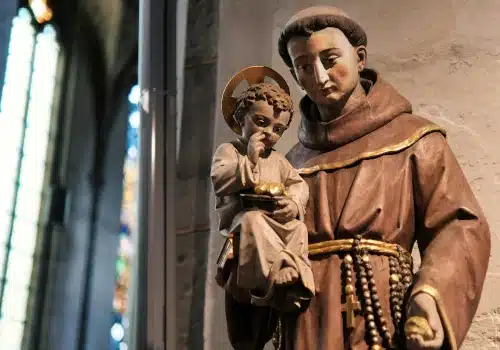
Why is St. Anthony pictured holding the Child Jesus?
The image recalls a traditional account of an apparition of the Child Jesus and expresses Anthony’s devotion to the Incarnation.
Does a prayer to St. Anthony guarantee a lost item will be found?
No. Catholics ask for his intercession and trust God’s wisdom. Prayer is an act of faith, not a formula that guarantees a particular result.
Sources and editorial notes
- Benedict XVI, General Audience, February 10, 2010: formation, preaching, Franciscan spirituality, and the Child Jesus image.
- St. Anthony Shrine: Who was St. Anthony?: life, Doctor of the Church, patronage, and charitable devotion.
- Basilica of St. Anthony: Miracle of the Mule and the speaking infant (Italian): traditional miracle accounts.
- Catechism, 956–957: the saints’ intercession through Christ.
- James 2:17 (USCCB): faith expressed in works.
This article adapts the supplied reflection. Historical biography, devotional narratives, and present-day spiritual application are distinguished. Traditional miracle accounts are presented as devotional tradition.