Witnesses of Faith · Franciscan lives
Venerable Placido Cortese: The Franciscan Priest Who Defied the Gestapo
A quiet priest. A hidden rescue network. A silence that protected lives.
- His life
- 1907–1944
- His vocation
- Conventual Franciscan
- His witness
- Heroic charity
Quick Catholic Answer
Venerable Placido Cortese (1907–1944) was a Conventual Franciscan priest who helped Jews, Allied soldiers, and other persecuted people escape Nazi persecution. Seized in October 1944, he died after torture in Trieste without betraying his collaborators. Pope Francis authorized recognition of his heroic virtues in 2021.
Venerable Placido Cortese, OFM Conv. (1907–1944), was a Franciscan priest whose quiet ministry at the Basilica of St. Anthony in Padua became part of a clandestine effort to save Jews, Allied soldiers, prisoners, and others persecuted during the Second World War. Arrested by Nazi agents in 1944, he was taken to Gestapo headquarters in Trieste and tortured for information. He refused to betray the people who had trusted him.
His courage did not begin with his arrest.
It began years earlier with a priest trying to live one simple conviction:
“Caritas Christi urget me.”
“The love of Christ impels me.”
His personal application of 2 Corinthians 5:14.
For Placido Cortese, those were not simply words from St. Paul.
They became the measure of his life.
Key Takeaways
- Venerable Placido Cortese was a Franciscan priest of the Order of Friars Minor Conventual.
- He was born Nicolò Matteo Cortese on March 7, 1907, in Cres, now part of Croatia.
- He served at the Basilica of St. Anthony in Padua and directed Messaggero di Sant’Antonio.
- During World War II, he assisted Jews, Allied soldiers, prisoners, refugees, and others facing persecution.
- He became an important contact in the clandestine FRA-MA rescue network.
- His activities included helping obtain false documents and arranging contacts for escape toward Switzerland. [3]
- Nazi agents seized him on October 8, 1944 and transported him to Gestapo headquarters in Trieste.
- Despite torture, he refused to reveal the names of his collaborators. [3]
- He died in November 1944.
- In 2021, the Church recognized his heroic virtues, and he is now properly referred to as Venerable Placido Cortese. [1]
Who Was Venerable Placido Cortese?
Placido Cortese was a priest of the Order of Friars Minor Conventual, the Franciscan community known as the OFM Conv.
Born Nicolò Matteo Cortese in 1907, he entered Franciscan life as a young man and eventually became a priest, confessor, spiritual director, and director of the Catholic publication Messaggero di Sant’Antonio.
Then Europe went to war.
As persecution intensified, Cortese began helping people endangered by imprisonment, deportation, and Nazi occupation. His work eventually connected him with the underground FRA-MA network, which helped persecuted people escape toward Switzerland. Franciscan sources describe him as an important point of contact in Padua and document his assistance to Jews, displaced Allied soldiers, and others sought by Nazi authorities. [2]
He was seized on October 8, 1944.
The Gestapo wanted names.
Placido Cortese gave them none.
He died after brutal interrogation and torture in Trieste around the middle of November 1944. [2]
The Church later formally recognized the heroic virtues of Placido Cortese. Pope Francis authorized the decree on August 30, 2021, advancing his cause and giving him the title Venerable. [1]
From Nicolò Cortese to Friar Placido
Placido Cortese was born Nicolò Matteo Cortese on March 7, 1907, on the island of Cres, then part of the Austro-Hungarian Empire and today in Croatia.
The Franciscan presence entered his life early.
The Friars Minor Conventual served at the local Church of St. Francis, and in 1920, at only thirteen years old, Nicolò entered the Order's college in Camposampiero near Padua.
His vocation continued to develop.
He took the religious name Placido, completed his novitiate at the Friary of St. Anthony in Padua, and professed temporary vows on October 10, 1924.
Four years later, on October 4, 1928, he made his solemn profession at the Basilica of St. Francis in Assisi.
He studied philosophy in Cres and theology at the Faculty of St. Bonaventure in Rome. Those who knew him remembered his modesty and kindness, characteristics that would remain evident throughout his life.
On July 6, 1930, he was ordained a priest in Rome. [2]
Nothing about those early years suggested that this quiet Franciscan would eventually find himself confronting one of the most brutal regimes of the twentieth century.
But holiness is rarely formed at the moment of crisis.
The crisis reveals what has already been formed.
A Franciscan Priest at the Basilica of St. Anthony
After his ordination, Father Placido served from 1931 to 1933 at the Basilica of St. Anthony in Padua.
He heard confessions.
He offered spiritual direction.
He ministered to young people.
He lived the ordinary life of a Franciscan priest.
From late 1933 until early 1937, he served in Milan as an assistant pastor at the parish of the Blessed Virgin Immaculate and St. Anthony.
Then he returned to Padua.
In 1937, Cortese became director of Messaggero di Sant’Antonio, the influential Catholic publication associated with the Basilica. Under his leadership, a new printing facility opened in 1939, and readership doubled. [2]
He was becoming an accomplished Catholic communicator.
Then the war transformed his ministry.
How World War II Changed His Ministry
Cortese's wartime resistance did not begin as an organized campaign against the Nazis.
It began with people who needed help.
During 1942 and 1943, he assisted Slovenian and Croatian detainees who had been deported to Italian internment camps, particularly the camp at Padua-Chiesanuova. [2]
Then came September 8, 1943.
Following the Italian armistice with the Allies, German forces occupied Padua. Jews, escaped Allied soldiers, political opponents, refugees, and others sought by Nazi authorities faced increasing danger.
The priest who had spent years hearing confessions and publishing a Catholic magazine now found himself confronting a very different question:
What does Christian charity require when helping another person could cost you your life?
For Placido Cortese, the answer was not theoretical.
He helped.
How Placido Cortese Helped Jews, Prisoners, and Refugees
Father Placido became increasingly involved in clandestine rescue efforts.
People in danger needed documents.
They needed contacts.
They needed safe routes.
They needed people they could trust.
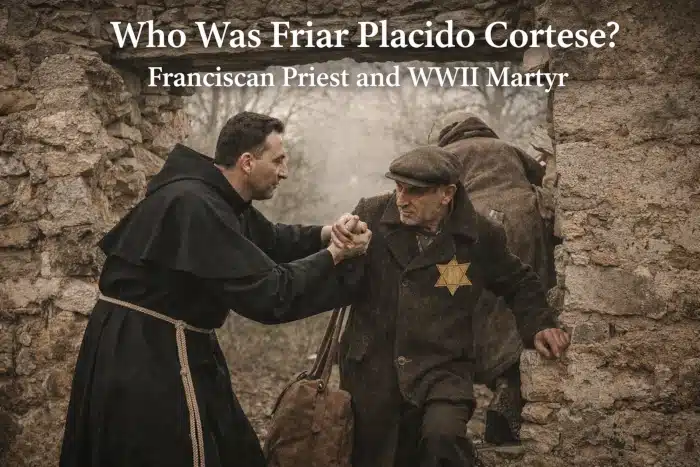
Cortese helped people obtain false identification documents. He arranged contacts and assisted fugitives trying to reach Switzerland. [3]
He continued to help.
The rescue effort depended on Cortese and the collaborators who helped people reach safety. [5]
We should not reduce those lives to numbers.
They were people.
That distinction matters.
Christian charity does not begin with abstractions.
It begins when the person standing before us becomes our neighbor.
The FRA-MA Rescue Network
Cortese became an important link in an underground rescue organization known as FRA-MA.
The name came from Ezio Franceschini, a professor at the Catholic University of Milan, and Concetto Marchesi, rector of the University of Padua.
Its purpose was practical and extraordinarily dangerous.
The network helped people being hunted by Nazi authorities escape to safety, often through routes leading toward Switzerland.
Father Placido became one of its important contacts in Padua. [2]
His position was unusually useful.
He was a priest at one of Europe's great pilgrimage churches.
People came and went constantly.
He heard confessions.
He met people privately.
And that ordinary priestly environment could provide cover for extraordinary acts of charity.
The Confessional That Became Part of a Rescue Network
One of the most striking parts of Cortese's story is the role associated with his confessional at the Basilica of St. Anthony.
A confessional is normally a place where sins are confessed and absolution is given.
For Father Placido, it also became associated with clandestine contacts and communication.
The contrast is remarkable.
There were no weapons.
No military headquarters.
No public speeches.
No uniform of resistance.
There was a Franciscan friar sitting in a church.
Yet behind that quiet exterior, people were being helped to escape persecution.
It is an important reminder that courage does not always look dramatic while it is happening.
Sometimes courage looks remarkably ordinary.
“The Love of Christ Impels Me”
Years before the most dangerous period of his life, Cortese had already identified the principle that guided him.
In a 1933 letter, he applied to himself the words of St. Paul:
“Caritas Christi urget me.”
2 Corinthians 5:14; Cortese’s personal wording uses “me.”
The expression comes from 2 Corinthians 5:14:
“The love of Christ impels us.”
Franciscan documentation specifically connects this Pauline phrase with Cortese's understanding of solidarity and charity. [2]
That helps us understand what happened later.
Placido Cortese did not suddenly become courageous in 1944.
His final courage grew out of a Christian life already centered on charity.
Prayer prepared him.
Religious life prepared him.
The priesthood prepared him.
Years of serving ordinary people prepared him.
Then history placed extraordinary demands upon an apparently ordinary priest.
Arrested by the Gestapo
By 1944, the rescue network had become increasingly dangerous.
Informants had penetrated resistance activities.
People were being arrested.
Father Placido knew there was reason to be cautious.
On Sunday, October 8, 1944, at approximately 1:30 in the afternoon, two men working for the Nazi SS approached him under a pretext.
Cortese entered their vehicle outside the Basilica.
He would never return.
He was taken to Trieste, where the Gestapo maintained headquarters in Piazza Oberdan. [2]
The priest who had spent years listening to other people's confessions was now being interrogated himself.
His captors wanted information.
Most importantly, they wanted names.
Torture, Silence, and Death
The Gestapo tortured Cortese in an effort to force him to identify the people who had participated in the rescue network.
He refused.
That silence is one of the defining facts of his life.
He knew names.
He knew contacts.
He knew people who had helped fugitives obtain documents, find shelter, travel safely, and escape.
Giving the Gestapo that information could have saved him from further suffering.
It could also have condemned others.
He remained silent. [3]
The precise details surrounding his death are difficult to reconstruct completely.
Franciscan accounts place his death around mid-November 1944 after repeated torture in Trieste. The Vatican decree records the month, without giving an exact day. His body was never recovered. Vatican News reports that it may have been cremated at the Risiera di San Sabba, the Nazi detention and killing facility in Trieste. That possibility should not be presented as an established fact. [4]
He was thirty-seven years old.
His brother friars had no recovered body to bury.
There was only the silence he had refused to break.
Why Did Placido Cortese Refuse to Betray His Friends?
This may be the most important question in his story.
Why remain silent under torture?
Why protect other people when speaking might end your own suffering?
From a Catholic perspective, Cortese's actions cannot be separated from his understanding of charity.
“The love of Christ impels us.”
He had spent years professing that Christian love requires something from us.
Eventually, those words required everything.
Jesus tells His disciples:
“No one has greater love than this, to lay down one's life for one's friends.” John 15:13
For most Christians, that command is lived through small sacrifices.
We give our time.
We forgive.
We care for the sick.
We feed someone who is hungry.
We defend someone who is being mistreated.
We remain faithful when faithfulness is inconvenient.
Placido Cortese encountered the extreme end of the same Christian command.
The people whose names he carried in his memory depended upon his silence.
So he remained silent.
Explore the dignity of the human person in our guide to Catholic social teaching.
Was Placido Cortese a Martyr?
Cortese is frequently described in Franciscan commemorations as a “martyr of charity.”
That language expresses the way Catholics and Franciscans understand his sacrifice, but it is important to distinguish devotional or historical descriptions from the formal canonical process.
The Church has formally recognized something specific:
Placido Cortese lived the Christian virtues to a heroic degree.
On August 30, 2021, Pope Francis authorized the Congregation for the Causes of Saints to promulgate the decree recognizing his heroic virtues. [1]
That decree is why he is now called Venerable Placido Cortese.
His cause for beatification and canonization continues within the Church's formal process.
So while his death is widely remembered as martyrdom and his story is inseparable from his suffering at the hands of the Gestapo, Catholics should distinguish that description from a formal Church decree recognizing martyrdom.
Why Is Placido Cortese Called “Venerable”?
Catholic titles in a canonization cause have specific meanings.
When Cortese's cause began, he was known as a Servant of God.
That is why older articles and Franciscan webpages may still use that title.
But his cause advanced.
On August 30, 2021, Pope Francis authorized the decree recognizing the heroic virtues of the Servant of God Placido Cortese. [1]
Recognition of heroic virtue permits a candidate in this type of cause to be referred to as Venerable.
That makes Venerable Placido Cortese the appropriate current title.
It does not mean he has been beatified or canonized.
Those are separate stages.
Related reading: what it means to be a saint.
The Cause for His Beatification
The Church's investigation into Cortese's life developed over many years.
Historical evidence, testimony, documentation concerning his priesthood, and records surrounding his wartime activity were collected and studied.
The Vatican's formal decree on heroic virtues came in 2021. The Holy See identifies him as a professed priest of the Order of Friars Minor Conventual. [1]
The recognition of heroic virtue points toward what makes his cause so compelling.
The Church is not interested in Cortese simply because he participated in historically significant events.
Heroism by itself does not make someone a saint.
The question is deeper.
What produced the heroism?
In Cortese's case, the Church has formally recognized the heroic character of the Christian virtues he lived.
His wartime actions cannot be separated from his faith.
Italy Remembered Him Too
Recognition of Cortese has not been limited to the Catholic Church.
In 2017, Italian President Sergio Mattarella conferred the Gold Medal of Civil Merit on Cortese posthumously. [2]
The civil recognition and the Church's cause approach his life from different perspectives.
One recognizes extraordinary service to other human beings during a period of persecution.
The other asks whether his entire life demonstrates heroic Christian virtue.
Both point toward the same remarkable historical fact.
A quiet Franciscan priest placed himself in danger because other people needed him.
What Catholics Can Learn From Venerable Placido Cortese
It would be easy to read Cortese's story and conclude that it belongs to another world.
Gestapo headquarters.
Secret escape routes.
False documents.
Nazi occupation.
Underground resistance networks.
Most of us will never encounter anything remotely similar.
But that can cause us to miss the lesson.
Cortese's final choices were extraordinary.
The virtues behind them were not.
Faith.
Charity.
Courage.
Prudence.
Loyalty.
Compassion.
Self-sacrifice.
These are virtues every Christian is called to practice.
We normally learn them through ordinary life long before we discover what they might eventually cost us.
Faith Does Not Always Look Heroic
There is a temptation to imagine saints and heroic Christians as people who somehow knew they were making history.
Placido Cortese's life suggests something different.
He became a Franciscan.
He studied.
He became a priest.
He heard confessions.
He counseled young people.
He worked at a Catholic magazine.
He helped prisoners.
Then he helped refugees.
Then he helped Jews and Allied soldiers escape.
Then the Gestapo came for him.
One act of faithfulness led to another.
That is often how Christian courage develops.
We do not begin by asking whether we are capable of heroic sacrifice.
We begin by asking whether we will be faithful today.
Will we tell the truth?
Will we defend someone who needs defending?
Will we help someone when helping is inconvenient?
Will we recognize Christ in the person who needs us?
Will we remain faithful when faithfulness begins to cost something?
Placido Cortese answered those questions long before entering a Gestapo prison.
That is why his final silence matters.
It was not an isolated moment of bravery.
It was the final expression of a life already given to Christ.
Caritas Christi urget me.
The love of Christ impels me.
For Venerable Placido Cortese, it finally impelled him all the way to the Cross.
Frequently Asked Questions
Who was Placido Cortese?
Venerable Placido Cortese was a Conventual Franciscan priest born in Cres, now part of Croatia, who helped Jews, Allied soldiers, prisoners, refugees, and other persecuted people during World War II. He was seized by Nazi agents in 1944 and died after torture in Trieste. [3]
Was Placido Cortese a Catholic priest?
Yes. Cortese was ordained to the Catholic priesthood in Rome on July 6, 1930, as a member of the Friars Minor Conventual. [2]
Why is Placido Cortese called Venerable?
Pope Francis authorized a decree recognizing Cortese's heroic virtues on August 30, 2021. This advancement in his cause means he is properly referred to as Venerable Placido Cortese. [1]
How did Placido Cortese help people during World War II?
Cortese participated in clandestine efforts that included helping persecuted people obtain false documents, arranging contacts, and assisting fugitives traveling toward Switzerland. He became an important contact in the FRA-MA rescue network. [3]
What was the FRA-MA network?
FRA-MA was an underground rescue network associated with professors Ezio Franceschini and Concetto Marchesi. It worked to help people being persecuted under Nazi occupation reach safety, including routes toward Switzerland. [2]
When was Placido Cortese arrested?
Nazi agents seized him on October 8, 1944, outside the Basilica of St. Anthony in Padua and took him to Trieste. [2]
When did Placido Cortese die?
He died in Trieste in November 1944, aged thirty-seven. Franciscan accounts place his death around the middle of the month; the Vatican decree does not specify an exact day. [2]
Is Placido Cortese a saint or a blessed?
The official sources reviewed identify him as Venerable, following recognition of his heroic virtues in 2021. That title does not mean he has been beatified or canonized. [1]
Was Placido Cortese formally declared a martyr?
The 2021 decree recognized heroic virtues. Descriptions such as “martyr of charity” express the witness of his life and death, but should not be confused with a decree formally recognizing martyrdom. [1]