

St. Francis de Sales: Patron Saint of Writers
A bishop and spiritual guide who joined doctrinal clarity with patience, gentleness, and a practical path to holiness.
Early Life, Education, and Vocation
Francis was born on August 21, 1567, at the Château de Sales in Savoy, near present-day Annecy, France. His noble family expected him to pursue law, public office, and marriage. He studied the humanities and theology in Paris before earning doctorates in civil and canon law at Padua.
During his student years, Francis suffered an intense spiritual crisis connected with questions about predestination. Fearing that he might be condemned, he placed his trust in God’s love rather than trying to solve the mystery through anxiety. This experience helped shape his later emphasis on confidence in divine mercy.
Despite his father’s plans, Francis discerned a vocation to the priesthood. He was ordained in 1593 after receiving his father’s reluctant consent. His education gave him a disciplined mind, while his personal struggles taught him how fear could burden the spiritual life. Both would serve his ministry as a preacher and spiritual director.
“God is the God of the human heart.”St. Francis de Sales, Treatise on the Love of God, cited by Pope Benedict XVI
The Mission in the Chablais
Soon after ordination, Francis volunteered to serve in the Chablais, a region south of Lake Geneva where Calvinism had become dominant. Public resistance made ordinary Catholic preaching difficult. Francis faced rejection, threats, and congregations too small to support a conventional mission.
He responded by writing short explanations of Catholic teaching and distributing them among local households. The pages were later collected as The Catholic Controversy. This use of accessible printed instruction became an important part of his association with writers and journalists.
Francis did not confuse gentleness with uncertainty. He presented Catholic doctrine clearly, but he refused to treat opponents with contempt. His method joined perseverance, reasoned explanation, personal conversation, prayer, and pastoral care. Over several years, many people in the region returned to Catholic practice.
Gentleness with a purpose
Francis’s gentleness was disciplined charity. He believed truth should be expressed in a manner suited to the person receiving it. His approach remains relevant wherever Catholics must explain the faith without turning disagreement into hostility.
Bishop of Geneva
Francis was consecrated Bishop of Geneva in 1602, although Calvinist control prevented him from residing in the city. He governed the diocese from Annecy, reforming clergy formation, visiting parishes, preaching, teaching catechism, and providing spiritual direction.
His episcopal ministry unfolded during the divisions following the Protestant Reformation. He upheld Catholic doctrine while cultivating patience in dialogue. That balance did not erase real disagreements, but it showed that conviction and charity need not oppose one another.
Francis also became a widely sought spiritual director. His many letters reveal careful attention to different personalities, duties, weaknesses, and stages of spiritual growth. He avoided the idea that one practice fits every Christian in exactly the same way.
This pastoral wisdom connects his work with the Church’s broader teaching about what it means to become a saint. Holiness is universal, but it is lived through the concrete responsibilities of each vocation.
Holiness in Everyday Life
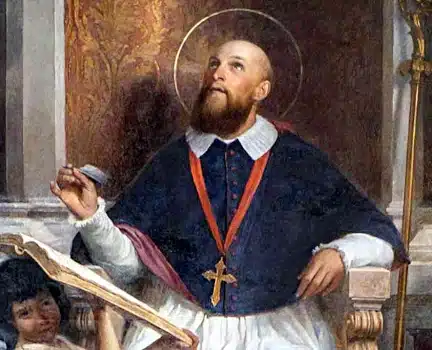
Introduction to the Devout Life, first published in 1609, grew from Francis’s spiritual direction of laypeople. Its central insight was striking for its time: devotion is not restricted to monasteries and clergy. Married people, workers, soldiers, servants, rulers, and widows are called to holiness within their circumstances.
Francis did not define devotion as a collection of pious feelings. It is charity made active and ready. Prayer, the sacraments, examination of conscience, virtue, friendship, and responsible work all belong to a life ordered toward God.
His counsel is practical because it respects ordinary limits. He asks readers to grow steadily rather than chase spiritual intensity. This approach complements Catholic practices such as examination of conscience and Lectio Divina, which form attention, repentance, and faithful prayer over time.
“Be patient, not only with respect to the main trials which beset you, but also under the accidental and accessory annoyances which arise out of them.”St. Francis de Sales, Introduction to the Devout Life, Part III, Chapter 3
The Treatise on the Love of God
Francis addressed Introduction to the Devout Life to beginners in the spiritual life. His later Treatise on the Love of God offers a deeper account of the human heart, grace, freedom, desire, and union with God.
Love is the organizing principle of his spirituality. God draws the human will without destroying freedom. Grace heals and elevates human nature, enabling a person to respond to God with love. Prayer and action therefore belong together, as do contemplation and faithful attention to daily duties.
Francis expected this love to be cultivated through regular prayer rather than occasional inspiration. His counsel fits within the wider Catholic tradition of prayer and spiritual life: make time for God, receive the sacraments, return patiently after failure, and let charity shape conduct toward other people.
His approach also illuminates the Christian virtue of humility. Humility is truthful dependence on God rather than self-contempt. It frees a person to receive grace, accept limitations, and serve without making holiness a performance.
“Everything pertains to love, everything is founded on love, everything is ordered to love and everything is love.”St. Francis de Sales, Treatise on the Love of God, cited in Totum Amoris Est
St. Jane de Chantal and the Visitation
Francis’s friendship with St. Jane Frances de Chantal became one of the great spiritual partnerships of the Church. Jane was a widow and mother who sought his direction after hearing him preach. Their correspondence reflects mutual respect, candor, and a shared desire for holiness.
In 1610 they founded the Order of the Visitation of Holy Mary. Francis envisioned a community marked by humility, simplicity, and charity, with a form of religious life accessible to women whose health or circumstances made more austere orders difficult.
Their friendship shows that spiritual direction is not control. Its purpose is to help another person discern and respond freely to God’s grace. Francis directed Jane firmly when needed, but also trusted God’s work in her soul.
Doctor of the Church and Patron of Writers
Francis died in Lyon on December 28, 1622. He was canonized in 1665 and declared a Doctor of the Church by Pope Pius IX in 1877. In 1923, Pope Pius XI named him the heavenly patron of Catholic writers.
His patronage fits both his method and his principles. Francis understood that writing can serve truth only when the writer’s life is also disciplined by truth and charity. Clear prose, patient explanation, and respect for the reader were pastoral responsibilities.
Pope Francis marked the fourth centenary of his death with the 2022 apostolic letter Totum Amoris Est, “Everything Pertains to Love.” The title captures the unity of his work. Whether addressing controversy, lay holiness, prayer, friendship, or religious life, Francis returned to love as the measure of Christian maturity.
For modern writers, teachers, and catechists, his example joins communication with character. Accuracy matters. Tone matters. The dignity of the reader matters. Gentleness is not a substitute for truth, but a virtue that helps truth be heard.
Frequently Asked Questions About St. Francis de Sales
Who was St. Francis de Sales?
St. Francis de Sales was the Catholic Bishop of Geneva, a spiritual director, co-founder of the Visitation Order, and author of major works on lay holiness and divine love.
Why is St. Francis de Sales the patron saint of writers?
His clear, charitable writing and his use of printed leaflets during the Chablais mission made him an enduring model for Catholic communication. Pope Pius XI formally named him patron of Catholic writers in 1923.
What are his most important books?
His best-known books are Introduction to the Devout Life and Treatise on the Love of God. The Catholic Controversy, sermons, and many letters also survive.
What did Francis de Sales teach about holiness?
He taught that every Christian is called to holiness and that devotion must be adapted to one’s vocation and responsibilities. Laypeople can grow in prayer and virtue in family, professional, and civic life.
What is Salesian spirituality?
Salesian spirituality emphasizes confidence in God’s love, gentleness, patient growth, freedom under grace, fidelity to daily duties, and charity as the center of the spiritual life.
When is the feast of St. Francis de Sales?
The Catholic Church celebrates his feast on January 24.