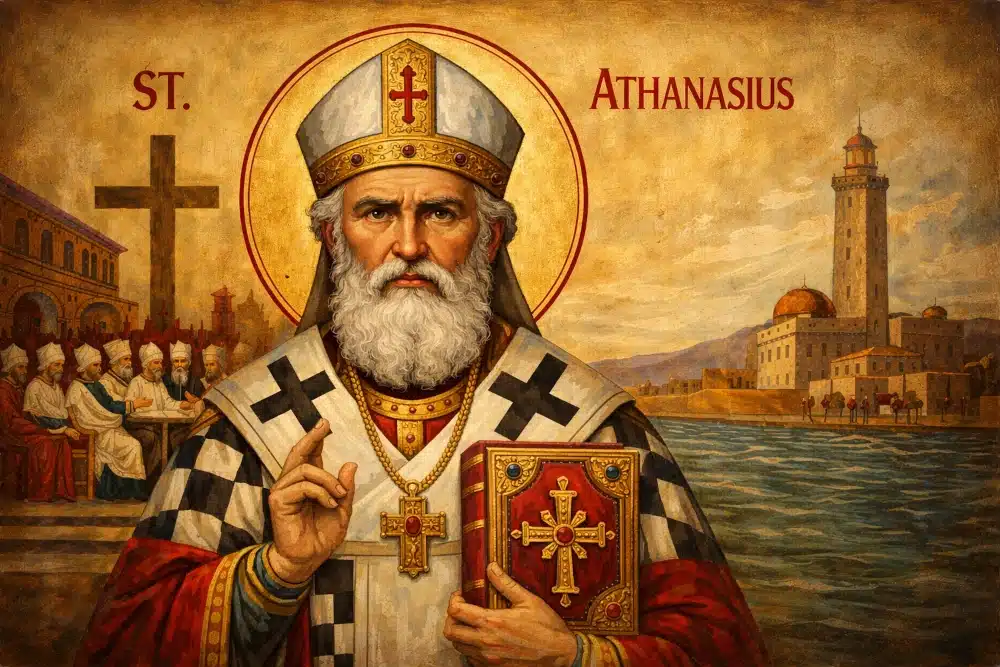
St. Athanasius defended the full divinity of Jesus Christ through decades of controversy and exile. His teaching made the stakes unmistakable: if the Son is not truly God, he cannot unite humanity to God or conquer death.
St. Athanasius was born in Alexandria, Egypt, around AD 296 to 298. Alexandria was one of the ancient world’s great centers of learning, where philosophy, rhetoric, biblical interpretation, and Christian theology met. Athanasius received a strong education, but his deepest formation came through the life and worship of the Church.
While still young, he came under the guidance of Bishop Alexander of Alexandria. Athanasius served him as a deacon and secretary, gaining firsthand experience in the theological dispute that would shape his life. He also developed lasting ties with Egypt’s ascetic and monastic communities.
His respect for monastic holiness later appeared in Life of Antony, the influential account of St. Anthony of the Desert. Athanasius did not separate doctrine from discipleship. Correct teaching about Christ mattered because it made possible a transformed Christian life.
“Pray continually; avoid vainglory; sing psalms before sleep and on awaking; hold in your heart the commandments of Scripture.”St. Athanasius, Life of Antony
Among Athanasius’s earliest major works are Against the Gentiles and On the Incarnation. Read together, they present a Christian account of creation, sin, death, and redemption. Humanity was made through the divine Word and for communion with God, but sin turned the human race toward corruption.
God did not abandon his handiwork. The eternal Word through whom all things were made assumed a real human body, offered it in death, and rose again. Salvation therefore comes from within the human condition. Christ enters the realm of death and breaks its power by divine life.
Athanasius’s teaching depends on the mystery of the Holy Trinity. The Son is not an intermediary creature standing between God and the world. He is eternally God with the Father. Because the Word is truly divine and truly human, communion with Christ truly joins believers to God.
“He was made man so that we might be made God.”St. Athanasius, On the Incarnation, 54, cited by Pope Benedict XVI
Athanasius is describing participation in God’s life by grace, not a change into the divine essence. Christ became human so that human beings could become adopted children of God and share in divine life.
Athanasius attended the Council of Nicaea in AD 325 as Bishop Alexander’s deacon and assistant. The controversy centered on Arius, a priest who taught that the Son was the first and greatest of God’s creatures rather than eternally divine.
The council confessed the Son as homoousios with the Father, meaning “of the same substance.” This word protected the biblical faith that Jesus Christ is “true God from true God,” not a lesser divine being. For Athanasius, the issue was directly connected to salvation. A creature cannot bestow God’s own life or overcome death by his own power.
The controversy continued long after the council ended. Some bishops rejected its formula, while others promoted ambiguous language that appeared peaceful but left room for Arian teaching. Athanasius consistently defended Nicaea because he understood that imprecise language about Christ could eventually alter the Gospel itself.
The word homoousios does not appear in Scripture, but the council used it to protect what Scripture reveals about the Son. Athanasius judged theological language by whether it faithfully expressed the biblical witness, especially the Son’s eternal relationship with the Father and his power to give divine life.
His defense also clarifies why Catholics profess a creed at Mass. The creed is not a list of detached propositions. It safeguards the identity and saving work of the God Christians worship.
After Alexander’s death, Athanasius became bishop of Alexandria in AD 328. The office placed him at the center of ecclesiastical and imperial conflict. His opponents used theological pressure, political influence, and personal accusations to remove him.
Athanasius endured five periods of exile under four emperors. He spent time in Trier, Rome, and the Egyptian desert, sometimes receiving protection from monastic communities. These years were not simply interruptions in his ministry. He continued writing, corresponding with churches, defending the Nicene faith, and encouraging Christians who faced confusion.
The phrase Athanasius contra mundum, “Athanasius against the world,” later summarized his resistance. It should not suggest that he stood alone or treated personal stubbornness as virtue. Many bishops, monks, clergy, and lay Christians supported the Nicene faith. The phrase captures his willingness to remain faithful when political power and influential churchmen opposed him.
His final years in Alexandria were comparatively peaceful. He continued teaching and governing until his death on May 2, AD 373. His feast is celebrated on May 2.
Athanasius left an extensive body of theological, pastoral, and historical writing. On the Incarnation remains his most accessible introduction to redemption through the Word made flesh. Orations Against the Arians presents his mature defense of the Son’s eternal divinity. Against the Gentiles addresses pagan religion and the knowledge of God through creation.
His Life of Antony became one of the most influential works of early Christian spirituality. Letters to Serapion defend the divinity of the Holy Spirit. His annual Festal Letters announced the date of Easter to the Egyptian churches and addressed pastoral concerns. The thirty-ninth Festal Letter is especially important because it lists the same twenty-seven New Testament books recognized by Catholics today.
These works show more than a controversialist. Athanasius wrote as a bishop concerned with worship, Scripture, holiness, Church unity, and the salvation offered in Christ.
Athanasius became known as the Father of Orthodoxy because he defended the Church’s confession of Christ through a prolonged period of instability. His work helped prepare the way for the Council of Constantinople in AD 381, which reaffirmed and expanded the Nicene confession.
His theology also influenced later Fathers and Doctors. Like St. Irenaeus before him, Athanasius connected salvation to the true Incarnation. Like St. Augustine after him, he helped the Church speak precisely about divine life and grace.
His witness offers a needed distinction between peace and compromise. Christian unity cannot rest on language that conceals disagreement about Christ. Authentic unity grows from truth received with humility and lived in charity.
“The Saviour raised his own body, and…brought death to nought, and bestowed incorruption upon all by the promise of the Resurrection.”St. Athanasius, On the Incarnation, Chapter 55
Lord Jesus Christ, eternal Word of the Father, Light from Light and true God from true God, you took flesh for our salvation and entered our mortal life so that we might be raised by your mercy into the life of grace.
We thank you for St. Athanasius, whom you strengthened in trial and steadied in exile. Through his intercession, preserve your Church from error, fear, and weariness. Grant us minds that love truth, hearts faithful to you, and lives that confess by deed what we profess with our lips.
Teach us to seek peace in truth, wisdom in faith, and courage in obedience. Keep us faithful until we rest in your presence forever.
Amen.
St. Athanasius was a fourth-century bishop of Alexandria, Early Church Father, and Doctor of the Church. He is best known for defending the full divinity of Christ during the Arian controversy.
Arius taught that the Son was created by the Father and therefore was not eternally God. The Council of Nicaea rejected this view and confessed the Son as true God and of the same substance as the Father.
Theological opponents and changing imperial policies repeatedly forced Athanasius from Alexandria. His defense of the Nicene faith made him a target during periods when emperors supported Arian or compromise positions.
Athanasius endured five periods of exile over approximately seventeen years. He continued writing and guiding the Church during these absences.
His surviving works include On the Incarnation, Against the Gentiles, Orations Against the Arians, Life of Antony, letters on the Holy Spirit, apologetic works, and numerous Festal Letters.
The Latin phrase Athanasius contra mundum honors his persistence when powerful political and ecclesiastical forces opposed the Nicene faith. It describes fidelity under pressure, not literal isolation from every other Christian.