Saint Paul began as Saul of Tarsus, a zealous Pharisee who opposed the early Church. After encountering Christ on the road to Damascus, he became one of Christianity’s greatest missionaries and teachers. His life and letters remain powerful witnesses to grace, conversion, and courage.
Saint Paul the Apostle, born Saul of Tarsus, was a Jewish Pharisee, Roman citizen, missionary, preacher, writer, and martyr. He was not one of the original Twelve Apostles, and he did not follow Jesus during the Lord’s earthly ministry. Still, his encounter with the risen Christ changed everything. After his conversion, Paul became one of the most powerful voices of the Apostolic Age.
Paul preached to Jews and Gentiles, founded Christian communities, trained believers, defended the faith, and wrote letters that became part of the New Testament. His influence extends throughout Christianity.
Paul was born Saul around the beginning of the first century in Tarsus of Cilicia, a respected center of trade and learning in the Greco-Roman world.
Jewish by faith and identity, he was also a Roman citizen by birth. He belonged to the tribe of Benjamin and described himself as a Pharisee, born of Pharisees.
According to Acts, Saul studied in Jerusalem under Gamaliel, receiving a deep formation in Scripture, interpretation, and Jewish law.
Paul’s Jewish formation was not erased after his conversion. It became part of how he preached Christ. He knew the Scriptures. He understood covenant, sacrifice, law, promise, and prophecy. When he later preached Jesus as the fulfillment of God’s plan, he was not speaking as an outsider. He was speaking as someone formed by Israel’s faith.
Paul also worked with his hands. He is commonly associated with tent making, leather work, or related trade labor. This detail matters too. Paul was not only a preacher in public spaces. He was also a working man who knew ordinary labor, ordinary exhaustion, and the dignity of earning his bread.
Before becoming a missionary, Saul actively persecuted Christians because he believed they threatened the faith of Israel.
Acts places Saul at the martyrdom of Saint Stephen and describes him as approving of Stephen’s death.
Saul thought he was defending God. His example warns that sincere religious zeal, when separated from truth and humility, can become destructive.
Paul’s life shows that a sinful past does not place anyone beyond the transforming power of Christ’s grace.
The turning point came as Saul traveled to Damascus to arrest Christians. A light from heaven surrounded him, and he heard Christ ask, “Saul, Saul, why are you persecuting me?”
Christ’s words reveal His union with the Church: to persecute His people is to persecute Him.
Saul was blinded for three days. He did not eat or drink. The man who had been so certain was now helpless, waiting, silent, and dependent. That kind of blindness was not just physical. It revealed the deeper blindness he had been living with.
God then sent Ananias, who overcame his fear, called Saul brother, prayed over him, and welcomed him to Baptism.
First, Christ takes the initiative. Saul did not reason his way peacefully into Christianity. Christ came to him. Second, Saul had to respond. He had to receive help, accept baptism, and begin a new life. Grace is always God’s gift, but it still asks for our yes.
From that moment forward, Saul’s life belonged to Christ. The persecutor became a preacher. The enemy became a brother. The man who had hunted Christians was now willing to suffer with them.
After his conversion, Paul began preaching that Jesus is the Son of God. This shocked people. And honestly, it should have. Imagine hearing that the man who once opposed Christians was now standing in the synagogue proclaiming Christ. Some were amazed. Others were suspicious. That is understandable.
Paul spent time in Damascus and also went into Arabia before returning to Damascus. Some have seen this period as a time of prayer, reflection, and preparation. He had encountered Christ, but he still needed to understand the full weight of his calling.
Later, Paul went to Jerusalem. He met Peter and James and stayed with Peter for about fifteen days. This matters because Paul’s mission was both personal and ecclesial. He received his call directly from Christ, yet he was not creating a private religion. He was connected to the apostolic Church.
Paul’s preaching brought opposition quickly. Some people could not accept his conversion. Others opposed his teaching about Christ. But Paul kept going. He had already discovered something worth more than reputation, safety, or approval.
Paul was not content to stay in one place. His calling pushed him outward. He traveled through regions such as Cyprus, Asia Minor, Macedonia, Greece, and eventually Rome. Along the way, he preached, taught, debated, suffered, and founded Christian communities.
Antioch became an important missionary base where Paul worked with Barnabas. He also supported relief efforts in Jerusalem, showing that evangelization includes charity and solidarity as well as preaching.
One of Paul’s central roles was preaching to the Gentiles. This was a major turning point in Christian history. The Gospel was not only for one nation or one ethnic group. It was for all people. Paul defended this mission again and again, even when it created tension.
Paul teaches the Church to move outward. The Gospel must be shared and lived in real communities—a mission reaffirmed in the Church’s teaching on evangelization and Vatican II.
Paul became “all things to all” by adapting his approach without weakening the Gospel.
Paul’s letters are among Christianity’s most important writings. Written to communities facing real problems, they combine doctrine with practical pastoral guidance.
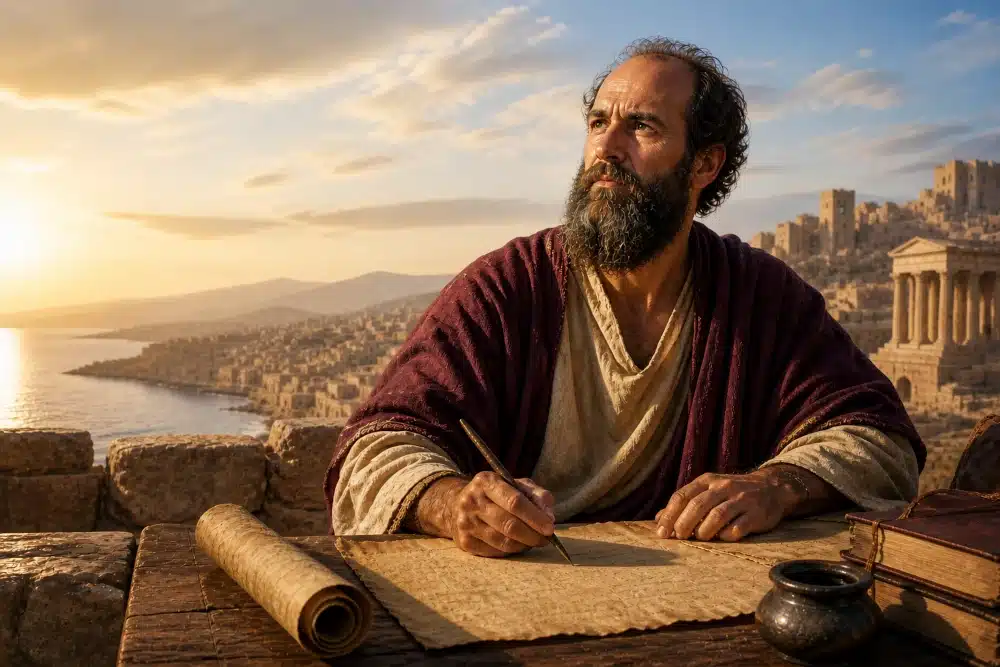
Paul was not writing theology for a quiet library shelf. He was correcting confusion, encouraging tired believers, answering disputes, defending the resurrection, explaining grace, and reminding Christians how to live as members of Christ’s Body.
They address faith, grace, sin, baptism, unity, charity, marriage, suffering, spiritual gifts, worship, and resurrection—a complete Christian life rather than a vague spirituality.
Their tender, sharp, joyful, and sometimes frustrated tone also reveals a pastor who cared deeply for his communities.
Paul’s ministry came at a cost. He faced rejection, beatings, threats, imprisonment, and shipwreck. He was opposed by some Jewish leaders, misunderstood by outsiders, and sometimes burdened by the very churches he loved.
At one point, Paul spent about two years imprisoned in Caesarea. Later, he appealed to Caesar and was sent toward Rome. During that journey, he was shipwrecked on Malta. Even there, he continued serving and witnessing. Paul did not wait for perfect conditions to be faithful.
In Rome, Paul spent time under house arrest. Yet he continued to preach. This is one of the most striking parts of his life. Chains limited his movement, but they did not silence his mission.
Paul did not treat suffering as proof that God had abandoned him. He saw suffering as a place where Christ could still be proclaimed. This does not make suffering easy. But it does mean suffering can become holy when united to Christ.
Paul measured success differently than the world does. He did not measure it by comfort, popularity, safety, or applause. He measured it by faithfulness to Christ.
Christian tradition holds that Paul joined the Church’s early martyrs when he was beheaded in Rome under Emperor Nero around AD 67.
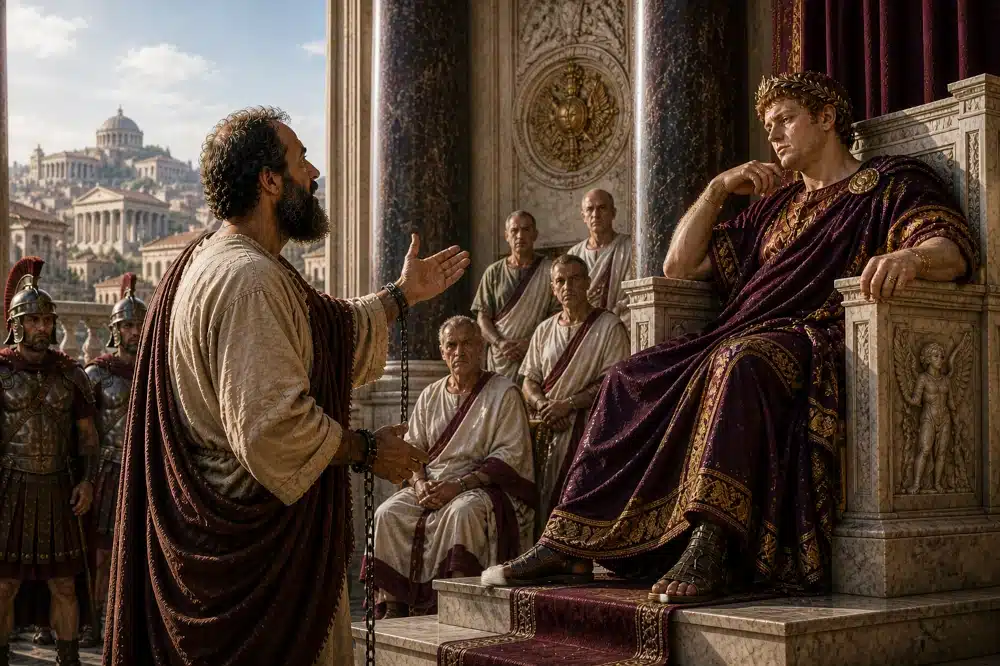
Nero’s persecution of Christians was brutal, and Paul’s final arrest likely took place within that climate of hostility. Some traditions suggest that Nero knew of Paul personally. However the final details are understood, the heart of the story is clear. Paul died as a witness to Christ.
Martyrdom is not simply dying for an idea. For Christians, martyrdom means bearing witness to a Person. Paul did not die for a theory. He died for Jesus Christ, the risen Lord who had met him on the road to Damascus and claimed his life forever.
Paul’s Jewish name was Saul, likely connected to King Saul, who also came from the tribe of Benjamin. His Roman name was Paulus, or Paul, a name often understood to mean “small.” After his conversion, he is commonly known as Paul, especially in his mission to the Gentile world.
The name shift is meaningful, but it should not be treated like a magic trick where one person disappears and another appears. Paul remained Jewish. He remained formed by the Scriptures. But as his mission moved into the wider Greco-Roman world, the name Paul fit his calling and audience.
That tells us something about missionary wisdom. Paul knew how to speak across cultures. He knew when to explain, when to challenge, and when to build bridges. He did not change the Gospel, but he worked hard to make it understood.
Paul adapted his approach depending on his audience. That is not the same as compromising the faith. Real evangelization keeps Christ at the center while speaking in a way people can actually hear.
Saint Paul still matters because the questions he faced have not disappeared. How are we saved? What is grace? How should Christians live in a pagan culture? How does the Church remain united? What do we do with suffering? How do we preach Christ to people who do not share our background?
He addressed those questions while traveling, preaching, suffering, praying, and caring for imperfect Christian communities.
His legacy is not only intellectual. It is pastoral. He teaches the Church how to think and how to love. He teaches believers how to suffer without losing hope. He teaches missionaries how to speak boldly. He teaches sinners that the past does not get the final word when Christ steps in.
Alongside Saint Peter and the Apostles, Paul stands as a pillar of the Church and a model of apostolic mission.
The Church celebrates Saint Paul with Saint Peter on June 29. This shared feast honors the two great apostles associated with Rome, martyrdom, and the foundation of the Church’s apostolic witness.
Other days connected to Saint Paul include January 25, the Feast of the Conversion of Saint Paul, February 16, connected in some traditions with his shipwreck, and November 18, the dedication of the Basilica of Saint Paul Outside the Walls.
Saint Paul is honored as a patron of missionaries, evangelists, writers, journalists, authors, public workers, theologians, Gentile Christians, and trades connected with tent making or similar crafts. His patronage fits his life. He preached, traveled, wrote, worked, suffered, and gave everything to Christ.
Catechist Reference Shelf
These sources provide historical grounding and Church-based teaching context for the life, mission, and theological importance of Saint Paul the Apostle.
Saint Paul’s transformation from persecutor to apostle reminds us that Christ can redirect any life toward grace, faithfulness, and mission.