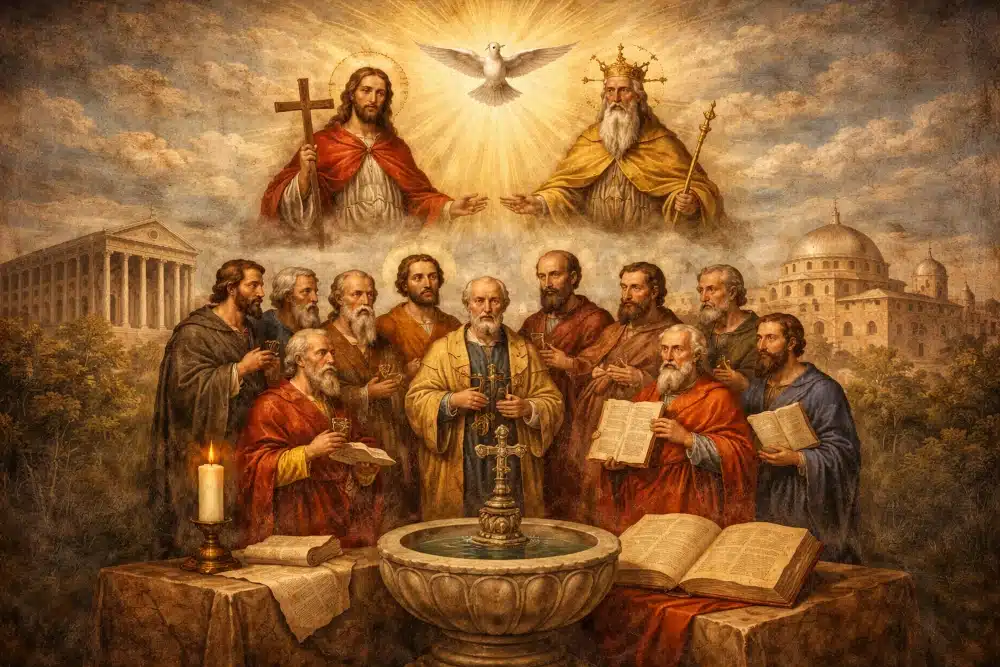
The Apostles’ Creed was not written line by line by the Twelve Apostles, but it does preserve the faith they preached. Its wording developed over time in the life of the Church, while its doctrinal core remained deeply apostolic.
The Apostles’ Creed, or Symbolum Apostolorum, is one of the best-known professions of faith in the Western Church. It is prayed at Mass, taught to children, memorized by catechumens, and used as a summary of what Christians believe. Because it feels so familiar, it is easy to assume it has always existed in exactly the same form. It has not.
Its confession of the Father, the Son, the Holy Spirit, the Church, forgiveness, resurrection, and eternal life also provides a framework for understanding the Catholic faith as a whole.
What the Church has received is older than the final wording. That is the heart of the matter. The creed did not appear all at once, but neither was it pieced together from scratch by later generations. It developed in the Church’s preaching, baptismal practice, and doctrinal life. So the best way to describe it is this: not literally authored by the Apostles in its final wording, but genuinely apostolic in faith.
That distinction matters, especially if we want to be both faithful and historically honest. The creed is not weakened by having a history. In one sense, its history is exactly what shows how deeply rooted it is.
The familiar story that each Apostle contributed one line to the creed works well as a symbol of unity, but not as a literal account of how the text took shape.
A long-standing tradition says that after Pentecost, but before going out on mission, the Apostles gathered and composed the creed together, each contributing an article. It is a memorable story, and for a long time it shaped catechetical imagination.
But historically, the evidence does not support that scene as a literal origin account. The legend appears later, especially in late antique and medieval sources, after the creed was already being treated as an ancient and authoritative summary of faith.
Even so, the tradition should not be dismissed as empty. It reflects the Church’s instinct that the creed is apostolic in substance. The faith it expresses is the faith the Apostles preached, even if the exact wording developed in the life of the Church over time.
The creed emerged from baptismal confession, scriptural preaching, and the Church’s rule of faith. It became more fixed over time, but its core was present very early.
The New Testament already gives the basic shape of Christian confession. Matthew 28:19 places baptism in the name of the Father and of the Son and of the Holy Spirit. Romans 10:8-10 speaks of confession and belief together. Romans 6:17 refers to a “form of doctrine” handed on.
In the second century, writers like Justin Martyr describe baptism in unmistakably Trinitarian terms. St. Irenæus speaks of one faith held throughout the world. Tertullian in North Africa lays out what he calls the rule of faith, and it sounds strikingly close to creedal form even when the wording varies.
Irenæus shows that the Church already understood herself as receiving one common faith from the Apostles, not a collection of local opinions.
By the third and fourth centuries, the Church’s baptismal profession had become even more stable. What later generations would call the Apostles’ Creed was growing out of something already real and already authoritative.
Early Christians often guarded the creed carefully, teaching it within formation rather than distributing it casually. That helps explain why the earliest written evidence can feel less direct than modern readers expect.
This is where the idea of the Disciplina Arcani helps. The Church treated some things with reserve, especially when they were closely tied to the sacraments and to catechumenal formation. The creed was one of those things.
Catechumens would receive it, learn it, and commit it to memory. It was not primarily something to be printed and passed around. It was something to be handed on carefully.
Cyril’s instruction makes the point clearly. The creed was meant to be received, internalized, and preserved faithfully.
So the relative lack of very early written copies does not mean the creed was absent. It means it was alive in the Church’s memory, teaching, and liturgical life.
The Old Roman Creed gives us a real glimpse of what Christians in Rome were already professing before the received Apostles’ Creed reached its fuller form.
Long before the Apostles’ Creed reached the wording many Catholics know today, Christians in Rome were already using a shorter baptismal symbol. Scholars call it the Old Roman Creed.
It already contained the essentials. Belief in God the Father Almighty. Belief in Jesus Christ, His Son. The Virgin Birth. The Passion under Pontius Pilate. The Resurrection. The Holy Spirit. The Church. Forgiveness of sins. The resurrection of the flesh.
That matters because it shows the later creed did not arise from theological improvisation. The structure was already there. The faith was already there. What came later was greater precision, not a new message.
Rufinus preserves a Roman form of the creed that shows how much of the later Apostles’ Creed was already firmly in place.
So the Old Roman Creed is not a rough draft waiting to be finished. It is the Church’s faith already confessed, just in a shorter form.
When the two forms are placed side by side, the relationship becomes obvious. The creed grows in clarity while remaining the same in doctrinal substance.
Old Roman Creed: I believe in God the Father Almighty.
Apostles’ Creed: I believe in God, the Father Almighty, Creator of heaven and earth.
Old Roman Creed: And in Jesus Christ, His only Son.
Apostles’ Creed: And in Jesus Christ, His only Son, our Lord.
Old Roman Creed: Born of the Holy Spirit and the Virgin Mary.
Apostles’ Creed: Conceived by the Holy Spirit, born of the Virgin Mary.
Old Roman Creed: Crucified under Pontius Pilate.
Apostles’ Creed: Suffered under Pontius Pilate, was crucified, died, and was buried.
Old Roman Creed: Rose again on the third day.
Apostles’ Creed: He descended into hell; on the third day He rose again.
Old Roman Creed: Ascended into heaven.
Apostles’ Creed: He ascended into heaven and is seated at the right hand of God the Father Almighty.
Old Roman Creed: The holy Church.
Apostles’ Creed: The holy Catholic Church, the communion of saints.
Old Roman Creed: The forgiveness of sins.
Apostles’ Creed: The forgiveness of sins.
Old Roman Creed: The resurrection of the flesh.
Apostles’ Creed: The resurrection of the body, and life everlasting. Amen.
Seen this way, the later creed does not erase the older one. It stands on it. The Church says more, but she is not saying something else.
The creed is not just a summary of ideas. It functions as a rule of faith, a baptismal profession, and a safeguard of Christian truth.
The Apostles’ Creed is Trinitarian from beginning to end. It is arranged around belief in the Father, the Son, and the Holy Spirit. That grows directly out of the Church’s baptismal identity.
It is also sharply Christological. It affirms the Virgin Birth, the Passion under Pontius Pilate, the burial, the Resurrection, the Ascension, and the future judgment. Every clause has weight.
And it is ecclesial. The creed does not stop with God and Christ in the abstract. It confesses the Church, forgiveness of sins, communion, resurrection, and eternal life. Christian faith is never merely private.
Tertullian’s language shows that the creed’s doctrinal substance was already functioning as a rule of faith before the later text became standard.
That is why the creed still matters. It is short enough to memorize, but large enough to carry the whole Christian story.
The Fathers do not always quote the exact later wording of the creed, but they consistently bear witness to its substance, structure, and authority.
Justin Martyr gives early evidence of Trinitarian baptism. Irenæus speaks of one faith received from the Apostles. Tertullian defines the rule of faith. Cyril of Jerusalem teaches the creed to catechumens. Rufinus comments on the Roman form. St. Ambrose links the symbol closely to the Roman Church.
Ambrose reinforces the Church’s conviction that the creed was a preserved inheritance, not a casual local formula.
St. Augustine captures the genius of the creed. It is short enough for memory, yet rich enough for a lifetime of reflection.
During this same patristic age, St. Jerome served the Church through biblical scholarship and a vigorous defense of the apostolic faith.
Put together, these voices show something important. The creed was not created in a vacuum. It emerged within a recognizable, stable, and already authoritative Christian tradition.
Modern scholars dispute details about wording, transmission, and exact stages of development, but the broader conclusion is clear: the creed grew from early Christian faith and Roman baptismal practice.
Some scholars, especially in older critical scholarship, pushed hard against traditional origin stories. Others emphasized the continuity between the old Roman baptismal symbol and the received text. Those debates still matter, but they no longer require an all-or-nothing choice.
The creed is not best defended by pretending every medieval legend is historical fact. Nor is it best understood by reducing it to a late theological convenience. Its real strength lies in continuity. It developed, yes. But it developed as a living summary of a faith already held and already preached.
That leaves us in a much healthier place. The creed is historically grounded, doctrinally stable, and ecclesially authoritative.
Learning the creed in Latin can deepen understanding and also help Catholics follow the same prayer across countries and languages.
For most Catholics, learning the creed in Latin is not about necessity. You do not need Latin to have faith, and you do not need Latin to pray well. But Latin does give something distinct.
It connects you to the Church’s memory. It also gives you a kind of liturgical bridge. If you are in another country, and the local language is not one you know, the Latin text can still be familiar enough to help you follow what is being prayed.
And there is another benefit. Latin slows people down. When the words are not automatic, they get heard again. That can deepen prayer rather than distract from it.
The traditional Latin text of the Apostles’ Creed remains a useful teaching tool, especially when paired with simple pronunciation help.
Credo in Deum, Patrem omnipotentem, Creatorem caeli et terrae.
(CRAY-doh een DAY-oom, PAH-trem om-nee-poh-TEN-tem, cray-AH-toh-rem CHAY-lee et TEHR-rye)
Et in Iesum Christum, Filium eius unicum, Dominum nostrum,
(Et een YEH-soom KREE-stoom, FEE-lee-oom EH-yoos OO-nee-koom, DOH-mee-noom NOH-stroom)
qui conceptus est de Spiritu Sancto, natus ex Maria Virgine,
(kwee kon-SEP-toos est deh SPEE-ree-too SAHNK-toh, NAH-toos eks mah-REE-ah VEER-jee-neh)
passus sub Pontio Pilato, crucifixus, mortuus, et sepultus,
(PAHS-soos soob PON-tsee-oh pee-LAH-toh, kroo-chee-FEEK-soos, MOR-too-oos, et seh-POOL-toos)
descendit ad inferos,
(deh-SHEN-deet ahd een-FEH-rohs)
tertia die resurrexit a mortuis,
(TEHR-tsee-ah DEE-eh reh-soor-REK-seet ah mor-TOO-ees)
ascendit ad caelos,
(ah-SHEN-deet ahd CHAY-lohs)
sedet ad dexteram Dei Patris omnipotentis,
(SEH-det ahd DEKS-teh-rahm DAY-ee PAH-trees om-nee-poh-TEN-tees)
inde venturus est iudicare vivos et mortuos.
(EEN-deh ven-TOO-roos est yoo-dee-KAH-reh VEE-vohs et mor-TOO-ohs)
Credo in Spiritum Sanctum,
(CRAY-doh een SPEE-ree-toom SAHNK-toom)
sanctam Ecclesiam catholicam,
(SAHNK-tahm ek-KLAY-see-ahm kah-THOH-lee-kahm)
sanctorum communionem,
(sahnk-TOH-room koh-moo-nee-OH-nehm)
remissionem peccatorum,
(reh-mee-see-OH-nehm pek-kah-TOH-room)
carnis resurrectionem,
(KAR-nees reh-soor-rek-see-OH-nehm)
vitam aeternam. Amen.
(VEE-tahm eye-TEHR-nahm. AH-men)
The creed is best taught not simply as a text to memorize, but as a compact telling of the Christian faith and the story of salvation.
A good way to teach the creed is to slow it down. One line at a time. Ask what each article is affirming. Ask what error it protects against. Ask what hope it gives.
The creed is especially powerful in catechesis because it is short enough to hold in memory but rich enough to keep unfolding. It can be taught to children, catechumens, and adults without losing depth.
In that sense, the creed is not only information. It is formation. It trains Christians to speak the faith with clarity.
These are some of the most common questions readers ask about the Apostles’ Creed, its origin, and its place in Christian faith today.
The Apostles’ Creed was not written line by line by the Twelve Apostles. It developed over time in the early Church. Still, it is called apostolic because it preserves the faith they preached.
Not as one single written passage. But its content comes directly from Scripture, especially the Church’s Trinitarian baptismal faith and its proclamation of Christ’s death and resurrection.
The Apostles’ Creed is shorter and older in structure, especially as a baptismal creed. The Nicene Creed is more detailed and was shaped by later doctrinal controversies, especially around the nature of Christ.
Because the creed roots Christian faith in real history. Jesus Christ suffered in a real place and time, not in myth or abstraction.
It does not mean Christ descended to the place of the damned. It refers to His descent to the dead, the realm of those awaiting redemption before the Resurrection.
Because it summarizes the Christian faith in a way that is brief, ancient, and doctrinally rich. It remains one of the clearest statements of what the Church believes.
Yes. It remains part of Catholic liturgy, catechesis, baptismal renewal, and personal prayer.
Latin can help Catholics pray the same text across countries and languages. It can also deepen attention and help people hear familiar words in a fresh way.
These sources ground the article in official Catholic teaching, traditional historical reference, and the Church’s current devotional and liturgical use of the creed.
This overview presents the Apostles’ Creed as a concise summary of the faith handed down from the Apostles. Drawing on Scripture, Church teaching, the Fathers, and historical sources, it recognizes that the creed’s wording developed over time while faithfully expressing the Church’s enduring beliefs.
The faith handed on
The Apostles' Creed gives Catholics a clear, memorable way to profess the faith received from the Apostles and lived in the Church.
Explore more Catholic answers