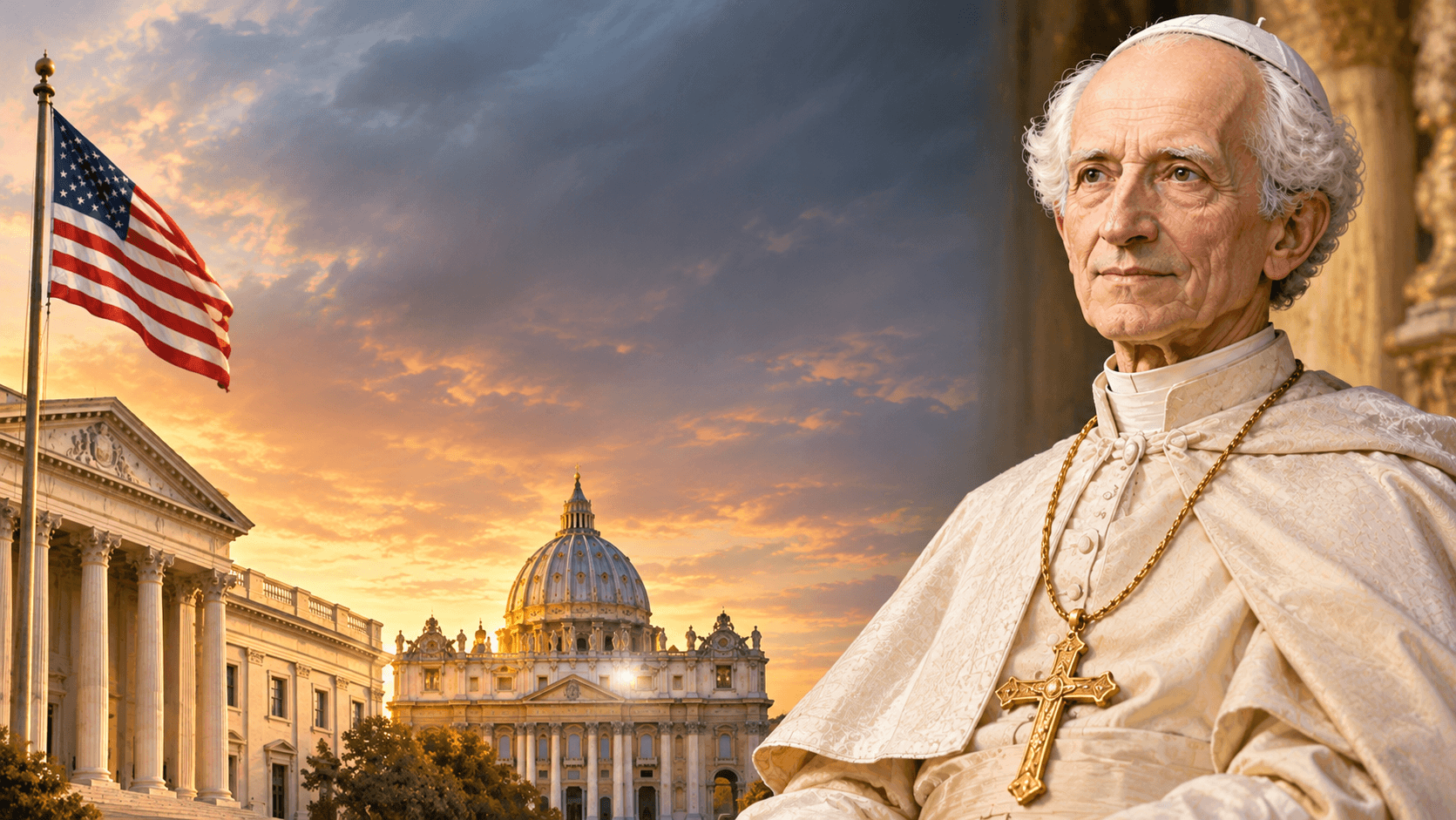
Pope Leo XIII · 1890
Faithful Citizenship
Sapientiae Christianae on faith, citizenship, socialism, and our duty to God
Quick Catholic Answer
Faithful Citizenship means serving the common good, respecting just laws, and putting obedience to God first.
Sapientiae Christianae is Pope Leo XIII's 1890 encyclical explaining the duties of Catholics as members of the Church and citizens of their country. It teaches that Christians should obey just laws, respect legitimate government, contribute to the common good, and participate responsibly in public life. However, when civil authority commands something contrary to God's law, Christians must obey God first.
The encyclical also emphasizes the responsibility of Catholics to understand and defend their faith, remain united with the Church, respect legitimate ecclesiastical authority, and act with courage, prudence, and charity.
Although it is not primarily an encyclical about socialism or communism, its principles help explain Leo XIII's broader opposition to political ideologies that reject divine authority, undermine natural rights, or subordinate the Church and family to the State.
Its central principle is simple: Human authority is legitimate, but it is never absolute.
Key Takeaways
- God comes first. Civil laws and political obligations cannot override divine law or the fundamental demands of morality.
- Patriotism is a Christian responsibility. Catholics should love their country, respect legitimate authority, and work for the common good.
- The Church rejects socialist and communist doctrines incompatible with natural law. Leo XIII specifically condemned attacks on private property, the family, legitimate authority, and religion.
- Catholic social teaching also demands economic justice. Defending private property does not excuse exploitation, unjust wages, or indifference toward the poor.
- Faith requires action. Catholics have a responsibility to learn, profess, and, when necessary, defend the teachings of the Church.
- The Church is not a political party. Catholics may disagree on prudential political questions without compromising their unity in faith.
- Obedience and conscience belong together. Christians must respect legitimate authority while recognizing that no human authority may command what is morally wrong.
- Charity governs Christian witness. Defending the truth never excuses hatred, arrogance, or contempt for others.
- Families form future generations. Parents have a fundamental responsibility to educate their children in faith and virtue.
What happens when loyalty to your country conflicts with your duty to God? Should Catholics remain silent when their faith is challenged? And how should Christians respond to political ideologies that place the authority of the State above the rights of individuals, families, and the Church?
These questions are not new.
On January 10, 1890, Pope Leo XIII issued Sapientiae Christianae, an encyclical commonly titled On Christians as Citizens. Written during a period of growing tension between the Catholic Church and secular political movements, the document addresses the responsibilities of Catholics toward God, the Church, their country, and one another.
The nineteenth century also witnessed the growing influence of socialism, communism, and revolutionary political movements. Leo XIII had already condemned certain doctrines associated with these movements in Quod Apostolici Muneris (1878). One year after Sapientiae Christianae, he would address economic injustice, private property, and the rights of workers in Rerum Novarum (1891).
Together, these encyclicals reveal a consistent principle: Neither the State nor any political or economic system possesses unlimited moral authority. All human institutions remain accountable to a higher moral order established by God.
Leo XIII does not encourage Christians to abandon public life. Nor does he suggest that political loyalty is inherently opposed to religious faith. Instead, he explains how these obligations should work together, why legitimate authority deserves respect, and what Christians must do when human commands contradict divine law.
His teaching offers something particularly valuable in an age of political division: a way to engage society without compromising the faith or confusing the Church's mission with the ambitions of a political party.
Why Did Pope Leo XIII Write Sapientiae Christianae?
To understand the encyclical, we must first understand the world in which Leo XIII wrote it.
The nineteenth century brought enormous changes to European society. Industrialization, scientific advancement, nationalism, and political revolutions transformed traditional institutions.
In several countries, governments sought to restrict the Church's influence over education, public affairs, and religious institutions.
The relationship between religious authority and political power became increasingly contentious.
At the same time, industrialization created serious economic and social problems. Workers often faced dangerous conditions, inadequate wages, and limited protection against exploitation. Poverty existed alongside growing industrial wealth.
These conditions contributed to the emergence and expansion of socialist and revolutionary movements, some of which proposed abolishing private property or fundamentally restructuring society.
Leo XIII recognized that material progress had brought genuine benefits. Yet he questioned whether a society could flourish if it pursued prosperity while neglecting moral responsibility and the spiritual nature of the human person.
His concern was not simply that governments might become less religious. He believed society itself would suffer when political institutions ceased to recognize moral truths higher than their own authority.
Material Progress Cannot Replace Moral Progress
Leo begins with a fundamental distinction between material prosperity and the deeper purpose of human life.
Wealth, education, technology, and political stability can improve human circumstances. They cannot, however, answer every question about human dignity, moral responsibility, or our ultimate destiny.
For Leo, the human person is created for communion with God. Society should therefore help people pursue lives of truth and virtue rather than treating material success as the highest good.
This distinction remains important today.
A nation may enjoy remarkable economic growth while struggling with corruption, injustice, family instability, or declining public trust. Technological progress does not automatically produce moral wisdom.
The question is not whether prosperity matters. It does.
The deeper question is whether prosperity alone can sustain a just society.
Leo XIII's answer is no.
Catholics Have Duties to Both God and Country
One of the most important teachings in Sapientiae Christianae concerns the relationship between patriotism and religious obligation.
Leo XIII does not dismiss patriotism as an inferior or unnecessary attachment. He recognizes love of country as a natural duty rooted in gratitude, community, and responsibility.
Christians benefit from the society in which they live. They therefore have obligations toward their neighbors, their communities, and the institutions that serve the common good.
These responsibilities include respecting legitimate authority, obeying just laws, contributing to public welfare, and defending the rights of others.
Yet Catholics also belong to the Church, whose mission extends beyond earthly life.
The Church exists to proclaim the Gospel, administer the sacraments, teach divine truth, and guide souls toward eternal salvation.
Consequently, the obligations of Catholics are not all equal in importance.
Why Does Loyalty to God Come Before Loyalty to Country?
Because God is the source of all legitimate moral authority.
Civil governments possess genuine responsibilities, but their authority is limited by the moral order. Governments may regulate public affairs, establish laws, and promote justice.
They cannot redefine good and evil simply through legislation.
In paragraphs 5–7, Leo XIII explains the relationship between love of country, love of the Church, and obedience to God.
Christians should love their earthly homeland while recognizing that their ultimate destiny lies with God.
This does not diminish responsible citizenship.
It gives citizenship its proper moral foundation.
A Catholic who refuses to participate in injustice is not necessarily rejecting the country. That person may be defending principles essential to the country's genuine well-being.
When Must Catholics Obey God Rather Than the Government?
Catholics must ordinarily obey legitimate civil authority. However, when a government requires conduct that directly contradicts divine law or fundamental moral obligations, obedience to God takes precedence.
This teaching rests on a principle established in the New Testament.
When religious authorities ordered the Apostles to stop preaching about Jesus Christ, Peter and the other Apostles responded:
“We must obey God rather than men.”
Leo XIII places this principle at the center of his discussion.
He teaches that legitimate law must serve justice and the common good. A command that violates the moral law cannot claim the same moral authority as a just law.
The distinction is essential because Christians are not called to unconditional obedience to every command issued by a government.
Neither are they free to reject laws merely because those laws are inconvenient, unpopular, or politically disagreeable.
What Makes a Law Unjust?
Catholic moral teaching recognizes that human laws must be evaluated in light of natural law, human dignity, justice, and divine revelation.
A law may be morally objectionable when it requires a person to commit wrongdoing, violates fundamental human rights, or attempts to prohibit obligations that God has established.
Consider three situations.
First, a law requiring wrongdoing. If civil authority commands someone to participate directly in an intrinsically immoral act, the Christian cannot justify that participation simply by appealing to legal requirements. Understanding how the Church evaluates moral actions helps clarify why a civil command cannot make an immoral act permissible.
Second, a law restricting religious duties. If authorities unjustly prohibit essential acts of religious worship or the proclamation of the Gospel, Christians must consider their obligations to God and the rights of the Church.
Third, an ordinary law that someone dislikes. Disagreement over taxes, administrative regulations, or public policy does not automatically establish a moral right to disobey.
The moral character of the command matters.
So does the response.
Does Catholic Teaching Permit Rebellion Against Government?
Not simply because a government acts unjustly.
This is an important distinction that is sometimes overlooked when discussing Sapientiae Christianae.
The Church recognizes the legitimacy of refusing immoral commands and defending fundamental rights. However, it does not treat every injustice as permission for violent resistance.
The Catechism of the Catholic Church, paragraphs 2242–2243, distinguishes conscientious refusal from armed resistance, which is subject to exceptionally strict conditions. Read Catechism
These include grave and prolonged violations of fundamental rights, exhaustion of other remedies, and a reasonable expectation that resistance will not create greater harm.
The Christian obligation is therefore neither blind submission nor indiscriminate rebellion.
It is fidelity to justice under the authority of God.
Catholics Must Know Their Faith Before They Can Defend It
Leo XIII understood that Catholics cannot faithfully explain teachings they do not understand.
He therefore urges believers to study Christian doctrine according to their abilities and circumstances.
This responsibility extends beyond memorizing prayers or knowing the basic requirements of religious practice.
Catholics should seek to understand what the Church teaches, why she teaches it, and how those teachings relate to Scripture, moral reasoning, and daily life.
The distinction between inherited faith and understood faith matters.
A person may grow up Catholic, attend Mass regularly, and sincerely believe in God while remaining unable to explain fundamental doctrines when questioned.
That lack of understanding can leave a person vulnerable to confusion, misinformation, or arguments that misrepresent Catholic teaching.
What Should Catholics Study?
A sound foundation includes Sacred Scripture, the Catechism, the sacraments, Christian morality, prayer, and the history and teaching authority of the Church. For an overview, start with what Catholics believe.
Study should also encourage humility.
The goal is not to win every religious argument or demonstrate superior knowledge. It is to grow in understanding so that faith can shape judgment, conduct, and relationships.
In paragraph 13, Leo XIII urges Catholics to study Christian doctrine according to their capacity and intelligence.
He also reminds believers that intellectual effort must be accompanied by prayer.
Faith is not merely an academic subject. It is a supernatural gift that must be nourished through grace.
Is Remaining Silent About the Catholic Faith Ever Wrong?
One of the strongest passages in Sapientiae Christianae concerns the responsibility to profess and defend the faith.
Leo XIII rejects the idea that defending Christianity belongs exclusively to bishops, priests, or trained theologians.
He cites St. Thomas Aquinas to explain that ordinary believers may have an obligation to make their faith known when circumstances require it.
That obligation can arise when fellow Christians need encouragement, when Catholic teaching is publicly misrepresented, or when silence would contribute to serious misunderstanding.
“Christians are, moreover, born for combat, whereof the greater the vehemence, the more assured, God aiding, the triumph”
But this teaching requires careful interpretation.
Not every conversation demands an argument. Not every criticism requires an immediate response. And not every Catholic is qualified to address every theological controversy.
Christian witness requires discernment.
Courage Is Not the Same as Confrontation
There is a difference between defending the faith and provoking unnecessary conflict.
A Catholic who calmly corrects a false statement about the Eucharist may provide a valuable service.
A Catholic who humiliates another person for asking a sincere question may undermine the very truth being defended.
The Apostle Peter provides a useful standard:
“Always be ready to give an explanation to anyone who asks you for a reason for your hope.”
The same passage calls for gentleness and reverence.
Courage and charity must remain together.
Leo XIII's teaching challenges two opposite tendencies: remaining silent out of fear and speaking aggressively without sufficient knowledge or prudence.
Neither reflects mature Christian discipleship.
The Laity Have an Active Role in the Mission of the Church
Catholics sometimes think evangelization is primarily the responsibility of clergy.
Leo XIII challenges that assumption.
Although bishops and the Pope possess the Church's teaching authority, lay Catholics also participate in her mission.
They do so through their conduct, their professions, their families, their conversations, and their public witness.
The distinction between these responsibilities matters.
A layperson does not possess the teaching office of a bishop. Nevertheless, that person can faithfully communicate the teachings received from the Church.
For example, a Catholic parent explaining the importance of Sunday Mass is participating in the Church's mission.
So is a teacher presenting Catholic doctrine accurately, a professional refusing dishonest practices, or a parishioner helping someone understand the sacraments.
Evangelization is not confined to a pulpit.
It occurs wherever Christians bear witness to Christ through their words and actions.
Why Does the Church Need Active Lay Catholics?
Because the Church encounters the world through her members.
Priests and bishops cannot personally reach every workplace, household, classroom, or public institution. Lay Catholics live and work within these environments every day.
Their presence creates opportunities to demonstrate that Christianity is not simply a collection of religious observances.
It is a way of life.
A Catholic who acts with integrity in business, treats others with dignity, protects vulnerable people, and explains the faith when appropriate makes Christian teaching visible.
But effective witness requires more than enthusiasm.
It requires formation, fidelity to the Church, and the humility to recognize the limits of one's knowledge and authority.
Why Does Pope Leo XIII Emphasize Unity With the Church?
For Leo XIII, defending the Catholic faith cannot become a purely individual undertaking.
The Church is not simply an organization of people who happen to share similar religious opinions.
Catholics believe she was established by Jesus Christ, entrusted with His teachings, and guided by the Holy Spirit.
That understanding has important consequences.
Catholics cannot claim complete independence from the Church's teaching authority while simultaneously presenting their personal interpretations as authentic Catholic doctrine.
Nor can they treat the Church as a political organization whose teachings may be revised whenever public opinion changes.
The Difference Between Personal Opinion and Catholic Doctrine
A Catholic may have strong opinions about economics, education, immigration, or government policy.
Some of those opinions may reflect legitimate applications of Catholic moral principles. Others may concern practical decisions on which faithful Catholics can reasonably disagree.
The distinction is between binding moral principles and prudential judgments about how best to apply those principles.
Consider the responsibility to care for people experiencing poverty.
The Church teaches that human dignity, justice, and concern for the poor are moral obligations.
Catholics may nevertheless disagree about the most effective combination of public assistance, charitable organizations, economic policies, and community initiatives.
Those disagreements do not necessarily indicate disagreement with Catholic doctrine.
However, Catholics cannot dismiss the underlying moral obligation merely because it conflicts with their political preferences.
Leo XIII's emphasis on unity requires believers to distinguish what the Church teaches from what they personally prefer.
Does Obedience Mean Catholics Cannot Ask Questions?
No.
The Catholic intellectual tradition includes theological inquiry, reasoned discussion, and the search for deeper understanding.
Respect for the Magisterium does not eliminate the responsibility to study or the possibility of respectfully asking questions.
At the same time, questioning a teaching is not identical to rejecting the Church's authority to teach.
Leo XIII warns against treating personal preference as the ultimate standard of religious truth.
Catholic teaching also recognizes different levels of magisterial authority and corresponding forms of assent.
Not every papal statement is an infallible definition, and not every prudential decision carries the same authority as a doctrine of faith.
The essential principle remains that Catholics should approach the Church's authentic teaching with fidelity, humility, and a sincere desire to understand.
The Church Is Not a Political Party
This is one of the most important lessons in Sapientiae Christianae for contemporary Catholics.
Leo XIII recognizes that political questions frequently involve legitimate differences of opinion.
He also insists that the Church must not surrender her independence to a political faction.
In paragraph 28, he explains that the Church must not subordinate herself to the changing demands of partisan politics.
The Church's mission is universal. Political parties, by contrast, organize themselves around particular policies, constituencies, and governing priorities.
Even when a party supports policies consistent with Catholic moral teaching, the Church cannot be reduced to that party's platform.
Can Catholics Support Different Political Parties?
Yes, provided their political commitments do not require them to reject fundamental Catholic moral principles.
Catholics may reach different prudential conclusions about particular policies, candidates, and political arrangements.
Such disagreements require careful moral judgment.
They do not justify treating every political preference as though it were a doctrine of the Church.
The opposite error is equally serious.
Political disagreement cannot be used as an excuse to disregard established moral teachings concerning human life, justice, religious freedom, or human dignity.
A Catholic should evaluate political choices through the lens of faith rather than evaluating the faith through the lens of political loyalty.
When Political Identity Becomes Stronger Than Religious Identity
Political movements often encourage intense loyalty.
That loyalty can become spiritually dangerous when believers begin defending everything associated with their preferred party while dismissing moral concerns raised by the Church.
The danger appears in several ways.
A Catholic may excuse dishonesty because it benefits a favored candidate.
Another may reject an established moral teaching because it conflicts with a preferred policy.
Still another may treat Catholics who disagree on prudential questions as enemies of the faith.
In each case, political allegiance threatens to displace Christian judgment.
Leo XIII's teaching offers a corrective.
The Catholic faith must inform political participation, but political affiliation must never become the measure of Catholic faithfulness.
This principle does not require Catholics to withdraw from political life.
It requires them to participate without surrendering their moral independence.
How Should Catholics Participate in Public Life?
Catholic citizenship involves more than voting or supporting candidates.
It includes contributing to the common good through honest work, community service, responsible political participation, and concern for those whose rights are threatened.
The Catechism of the Catholic Church, paragraphs 2238–2240, teaches that citizens have responsibilities toward legitimate civil authority and society. Read Catechism
These include civic participation, paying taxes, and contributing to the welfare of their country.
Leo XIII approaches these obligations from the perspective of Christian discipleship.
Catholics should not abandon public affairs to those who disregard moral principles.
They should instead bring well-formed consciences, sound judgment, and concern for justice into civic life.
Five Practical Ways Catholics Can Apply This Teaching
- Form your conscience before making political decisions. Study Scripture, Catholic moral teaching, and the issues involved rather than relying exclusively on political commentary.
- Distinguish principles from policy preferences. Identify what the Church teaches as morally binding and where legitimate prudential disagreement remains possible.
- Evaluate conduct as well as promises. Consider integrity, competence, justice, and respect for human dignity when assessing public leaders.
- Defend religious freedom and the rights of others. The common good includes protecting the dignity and legitimate rights of people beyond one's own religious community.
- Practice charity in political disagreements. Refuse dishonesty, contempt, and personal attacks, even when defending an important moral principle.
These responsibilities extend beyond elections.
Catholics participate in public life whenever they serve their neighbors, protect the vulnerable, advocate for justice, or demonstrate moral integrity in their daily responsibilities.
The Two Dangers: False Prudence and False Zeal
Leo XIII identifies opposing tendencies that can undermine Catholic witness.
Both are particularly relevant when religious conviction intersects with public controversy.
False Prudence: Remaining Silent to Avoid Conflict
Prudence is a virtue. It helps people choose appropriate means to accomplish what is good.
But prudence can become an excuse for inaction.
A person may recognize a serious moral problem yet refuse to address it because speaking might invite criticism or discomfort.
Leo XIII warns against confusing fear with wisdom.
There are circumstances in which silence allows injustice or serious misunderstanding to continue.
Christian courage sometimes requires speaking even when doing so carries personal consequences.
Nevertheless, the duty to speak must be guided by the facts, one's responsibilities, and the circumstances involved.
False Zeal: Acting Without Humility or Obedience
The opposite danger arises when enthusiasm for defending the faith becomes detached from charity, prudence, or legitimate authority.
A person may sincerely believe that a religious cause is important while using methods that contradict Christian virtue.
False zeal can appear when Catholics treat their personal opinions as binding doctrine, attack Church leaders without fairness, or assume responsibilities that do not belong to them.
Religious conviction does not excuse arrogance.
Nor does the importance of a cause justify every method used to advance it.
Leo XIII calls for a more disciplined approach.
Three virtues are essential:
- Courage: Defend what is true and just.
- Prudence: Choose appropriate actions and recognize legitimate authority.
- Charity: Act with love, humility, and respect for others.
These virtues work together.
Courage without prudence can become recklessness.
Prudence without courage can become an excuse for silence.
And both lose their Christian character when separated from charity.
Why Christian Morality Matters to Society
Leo XIII argues that political institutions depend upon moral foundations that laws alone cannot create.
Governments can establish rules, enforce contracts, and punish criminal behavior.
They cannot, through legislation alone, guarantee honesty, generosity, self-restraint, or genuine concern for others.
A healthy society requires citizens who recognize obligations beyond immediate personal advantage.
Christian moral formation contributes to that goal by teaching responsibility before God and neighbor.
Can a Society Prosper Without Shared Moral Principles?
Material prosperity and moral health are not identical.
A society may possess advanced technology, efficient institutions, and considerable wealth while experiencing serious failures of trust and justice.
For Leo XIII, this demonstrates the limitations of treating economic or political achievement as the highest measure of human progress.
The stability of a community depends partly on whether its members practice virtues that sustain relationships and institutions.
Honesty makes commerce possible.
Justice protects human dignity.
Fidelity strengthens families.
Charity encourages responsibility for those in need.
These virtues cannot simply be manufactured through government regulation.
They must also be cultivated in individuals, families, schools, religious communities, and civic institutions.
This does not mean that only religious people can act morally or contribute to a just society.
Rather, Leo XIII argues that religion provides an essential foundation for understanding moral obligation and humanity's ultimate purpose.
Charity Must Govern the Defense of Truth
After discussing political conflict, religious opposition, obedience, and the responsibilities of Catholic citizens, Leo XIII returns to the importance of charity.
This is not a minor qualification.
It is essential to understanding his entire argument.
Christianity does not permit believers to defend truth through hatred.
Nor does the obligation to oppose wrongdoing eliminate the commandment to love one's neighbor.
Jesus teaches His disciples to love even their enemies (Matthew 5:44).
St. Paul likewise places charity at the center of Christian life.
The challenge is to hold together two obligations that modern discussions frequently separate: fidelity to truth and love for the person.
Charity Does Not Require Abandoning Moral Convictions
Catholics sometimes face the suggestion that disagreement itself is uncharitable.
That is not the Catholic understanding of charity.
A person can reject an idea while respecting the dignity of the person who holds it.
Likewise, a Catholic can defend a moral teaching without insulting those who disagree.
Charity concerns both what we seek for others and how we treat them.
It requires patience, honesty, fairness, and a sincere desire for their good.
The Christian goal is not simply to defeat an opponent.
It is to bear witness to truth in a manner consistent with the Gospel.
The Family Is the First School of Christian Citizenship
Leo XIII concludes his encyclical by emphasizing the importance of the family and the education of children.
His reasoning follows naturally from the rest of the document.
If society depends upon moral virtue, then the institutions that form moral character are essential to society's future.
The family holds a particularly important place because children first encounter authority, responsibility, sacrifice, forgiveness, and love within the home.
Parents are not merely responsible for providing food, shelter, and education.
They also possess a fundamental responsibility to guide the moral and spiritual development of their children.
Why Does Parental Example Matter So Much?
Children learn from what adults do as well as from what they say.
Parents who teach honesty but regularly practice deception send conflicting messages.
Parents who encourage prayer but never make time for it may struggle to communicate its importance.
By contrast, children who observe forgiveness, integrity, generosity, and faithful religious practice encounter Christian virtues as lived realities.
This does not guarantee that every child will embrace the faith as an adult.
Human freedom remains real.
Nevertheless, parental example can provide a powerful foundation for a mature Christian life.
The Catechism affirms the primary responsibility of parents for the education of their children in faith and virtue (CCC 2221–2231).
Leo XIII connects that responsibility to the wider welfare of society.
Strong moral formation within families contributes to the development of responsible citizens who understand that freedom must be exercised with concern for others.
What Does Sapientiae Christianae Teach Catholics Today?
Although Sapientiae Christianae was published in 1890, the moral questions it raises remain familiar.
How should Christians respond when political expectations conflict with religious convictions?
What responsibilities do Catholics have when public discussions misrepresent the faith?
How can believers remain faithful to Church teaching while participating in a politically divided society?
How should Catholics evaluate socialism, communism, capitalism, and other political or economic systems in light of Catholic moral teaching?
And how can Catholics defend moral principles without allowing anger or partisan loyalty to dominate their actions?
Leo XIII does not provide a detailed policy program for contemporary governments.
Instead, he offers principles by which Catholics can evaluate their responsibilities.
Those principles can be summarized through six questions:
| Question | Catholic principle |
|---|---|
| Where does my ultimate loyalty belong? | God and His moral law take precedence over human authority. |
| What do I owe my country? | Respect for legitimate authority, responsible participation, and service to the common good. |
| How should I evaluate political and economic ideologies? | By their respect for human dignity, natural rights, justice, and the proper limits of government. |
| What do I owe the Church? | Fidelity to her authentic teaching, unity, and cooperation in her mission. |
| How should I respond when the faith is challenged? | With knowledge, courage, prudence, and charity. |
| How should I approach political disagreements? | Distinguish binding moral principles from legitimate differences in prudential judgment. |
These principles challenge Catholics across the political spectrum.
They call believers to examine their own conduct before condemning the failures of others.
They also remind Christians that the credibility of their public witness depends upon the consistency of their private lives.
A person who publicly defends Christian morality but neglects justice, honesty, or charity undermines the message being proclaimed.
Authentic Catholic citizenship begins with authentic Christian discipleship.
Faithful to God, Responsible to Society
Sapientiae Christianae presents a demanding vision of Catholic life.
Pope Leo XIII calls Christians to love their country without making it an idol, respect civil authority without surrendering conscience, and defend the faith without abandoning charity.
His broader social teaching also challenges the assumption that political power or economic organization can solve humanity's deepest problems apart from moral responsibility.
He condemns socialist and communist doctrines that violate natural rights while insisting that employers, property owners, and governments have genuine obligations toward workers and the poor.
He insists that Catholics have responsibilities both within the Church and throughout society.
Those responsibilities cannot be fulfilled through political enthusiasm alone.
They require prayer, study, moral formation, participation in the sacramental life of the Church, and a willingness to place divine truth above personal convenience.
The encyclical also challenges Catholics to recognize that unity in faith does not demand uniformity in every political judgment.
The Church's mission transcends the divisions of earthly politics.
Her purpose is not to secure victory for a political faction but to proclaim Jesus Christ and guide humanity toward salvation.
For Catholics today, the enduring lesson is clear.
Be faithful to God. Serve your country. Defend the truth. Respect legitimate authority. Protect human dignity. Remain united with the Church. And let charity govern everything you do.
Catechist Notes
Read together. Begin with Acts 5:27–29 and Sapientiae Christianae §§5–7. Ask learners to name one duty Catholics owe their country and explain why obedience to God comes first.
Discuss a case. Compare disagreement with a public policy and a civil command to do something morally wrong. What makes the second case a matter of conscience? Use Catechism §§2238–2242 to guide the discussion.
Put it into practice. Ask each learner to name one way to serve the common good this week and one way to practice charity in a disagreement.
Frequently asked questions
What is Faithful Citizenship?
Faithful Citizenship means bringing a well-formed Catholic conscience into public life, respecting legitimate authority and working for the common good.
What should Catholics do when civil authority requires wrongdoing?
Catholics must refuse commands that require them to violate divine law or fundamental moral obligations. Ordinary disagreements about public policy do not justify disobedience.
Can Catholics disagree about public policy?
Yes. Catholics share binding moral principles and may reasonably disagree about how best to apply them in many public policy decisions.
Sources and Further Reading
The following primary sources provide the theological and historical foundation for this article.
1. Pope Leo XIII, Sapientiae Christianae (1890)
On Christians as Citizens
Primary source for the duties of Catholics toward God, the Church, and civil society, particularly paragraphs 5–16, 17–30, and the concluding sections on charity and family.
2. Pope Leo XIII, Quod Apostolici Muneris (1878)
On Socialism
Especially paragraphs 1 and 9, addressing socialism, communism, nihilism, private property, family, and legitimate authority.
3. Pope Leo XIII, Rerum Novarum (1891)
On Capital and Labor
Especially paragraphs 4–15 and 32–38, addressing socialism, private property, the rights of workers, economic justice, and the responsibilities of public authority.
4. Catechism of the Catholic Church, 2234–2246
Civil authority, duties of citizens, conscientious objection, and the relationship between the Church and political community.
5. Catechism of the Catholic Church, 2221–2231
The responsibilities of parents and the Christian education of children. Read Catechism 2221–2231
6. Sacred Scripture
- Acts 4:18–20 and 5:27–29: The Apostles' response to commands that conflict with their duty to God.
- Matthew 22:15–22: Jesus' teaching concerning obligations to Caesar and to God.
- Romans 13:1–7: St. Paul's teaching concerning legitimate governing authority.
- 1 Peter 3:15–16: Defending the faith with gentleness and reverence.
- Matthew 5:44: The Christian obligation to love one's enemies.
- Colossians 3:14: Charity as the bond of perfection.
Continue Exploring the Catholic Faith
Understanding the Church's teachings helps Catholics develop informed consciences, strengthen their spiritual lives, and respond thoughtfully to the challenges of modern society.
At San Isidro Catholic Church, faith formation provides opportunities to explore Scripture, Sacred Tradition, Catholic doctrine, and the responsibilities of Christian discipleship.
Whether you are returning to the Church, preparing to become Catholic, or seeking a deeper understanding of your faith, the journey begins with a willingness to learn.
Explore our resources on Catholic teaching, faith formation, and becoming Catholic.
Clear answers. Rooted in truth.