
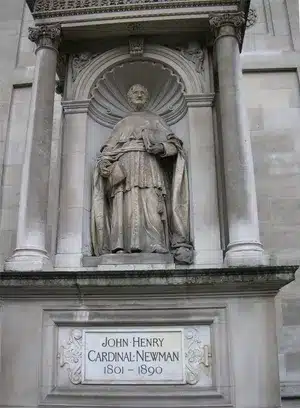
John Henry Newman is one of the most important Christian thinkers of the modern era.
He began as a celebrated Anglican preacher at Oxford, helped spark the Oxford Movement,
and eventually entered the Catholic Church out of loyalty to conscience and history.
Few figures in modern religious history have left a mark as profound as John Henry Newman. His journey from a devoted Anglican clergyman to one of the most influential Catholic thinkers of the 19th century is not just a tale of conversion—it’s a story of intellectual courage, spiritual struggle, and enduring faith. Newman’s pursuit of truth bridged two great Christian traditions and reshaped how believers understood conscience, doctrine, and reason.
John Henry Newman was born on February 21, 1801, in London, into a family that reflected England’s cultural crossroads—his father a banker of Huguenot descent, his mother a devout Calvinist. This blend of rational discipline and moral seriousness would quietly shape Newman’s character. From an early age, he was drawn to questions of eternity, the nature of God, and the moral life.
Newman’s education at Ealing School and later at Trinity College, Oxford, exposed him to the intellectual ferment of his age. The Enlightenment had loosened the hold of traditional belief, while Romanticism reawakened a sense of mystery and devotion. Somewhere between these currents, Newman began to form a distinctly personal faith—one deeply reflective, steeped in study, and animated by an inner sense of divine calling.
In 1825, he was ordained as an Anglican priest, and within a few years, became Vicar of St. Mary’s, Oxford, one of the most prestigious pulpits in England. His “Parochial and Plain Sermons”, preached at St. Mary’s, soon earned him admiration across the Church of England. They combined profound theology with literary grace, exploring the quiet movements of conscience and the call to holiness in ordinary life. Newman’s sermons did not thunder; they persuaded. They revealed a mind not content with abstract dogma, but one seeking to make belief live in the soul of the listener.
At this stage, Newman stood firmly within the Anglican Church—but he also began to sense that something vital was missing. He believed the church had drifted too far toward rationalism, losing its sense of sacred authority and continuity with the early Christian tradition. That conviction would soon find expression in one of the most significant movements in modern religious history.
Few figures in modern religious history have left a mark as profound as John Henry Newman. His journey from a devoted Anglican clergyman to one of the most influential Catholic thinkers of the 19th century is not just a tale of conversion—it’s a story of intellectual courage, spiritual struggle, and enduring faith. Newman’s pursuit of truth bridged two great Christian traditions and reshaped how believers understood conscience, doctrine, and reason.
PROCLAMATION OF ST. JOHN HENRY NEWMAN
AS
“DOCTOR OF THE CHURCH”
HOMILY OF POPE LEO XIV
St Peter's Square
All Saints' Day - Saturday, 1st November 2025
In the 1830s, Oxford was a hub of intellectual renewal and spiritual restlessness. Out of this environment emerged the Oxford Movement, a campaign to revive the Catholic heritage of the Anglican Church. Its leaders—John Keble, Edward Pusey, and especially John Henry Newman—sought to reaffirm the Church’s apostolic roots, sacramental life, and moral seriousness.
The purpose of the Oxford Movement was not to abandon Anglicanism but to restore its depth. The reformers believed that the Church of England was not merely a product of the Reformation but a continuation of the ancient, undivided Church of the apostles. They championed ideas of apostolic succession, liturgical reverence, and the authority of tradition alongside Scripture.
Newman quickly became the movement’s intellectual and spiritual center. His series of “Tracts for the Times”, written between 1833 and 1841, argued forcefully that the Anglican Church should reclaim its Catholic identity. However, the Tract 90, published in 1841, pushed boundaries by suggesting that the Thirty-Nine Articles—the doctrinal foundation of Anglicanism—could be interpreted in ways consistent with Catholic theology.
This interpretation caused an uproar. Many accused Newman of betrayal; university authorities censured his views. Yet, in private, Newman was experiencing a profound spiritual crisis. His study of early Church Fathers convinced him that the authority and unity he sought could only be found in the Roman Catholic Church.
John Henry Newman’s intellectual output after his conversion was vast and profound. His “Essay on the Development of Christian Doctrine”, written in 1845, became a cornerstone of modern Catholic theology.
In it, Newman argued that doctrine, like a living organism, grows and unfolds over time—not by changing its essence, but by deepening its understanding. This idea provided a framework for reconciling the Church’s evolving teachings with its ancient roots, profoundly influencing later theological developments, including the Second Vatican Council.
His philosophical approach was both rigorous and poetic. Newman viewed theology as a disciplined science, but one animated by faith. He resisted the reduction of religion to mere logic or moralism. Instead, he proposed that belief arises from what he called the “illative sense”—a faculty by which the human mind synthesizes experience, intuition, and reason to grasp spiritual truth. In works such as “The Grammar of Assent” (1870), he explored how faith could be intellectually credible while remaining deeply personal.
Newman’s writing style combined the clarity of a philosopher with the sensitivity of a poet. His essays and sermons bridge intellect and devotion, making him one of the few theologians whose prose continues to move both scholars and lay readers alike.
Beyond theology, Newman’s literary achievements include essays on education, history, and literature. He founded the Oratory of St. Philip Neri in Birmingham, establishing a center for prayer, teaching, and pastoral care. His work in education culminated in the founding of the Catholic University of Ireland, where he delivered a series of lectures later collected as “The Idea of a University”—a masterful vision of liberal education that still resonates today.
By 1845, after years of study, prayer, and soul-searching, Newman made the most consequential decision of his life—his conversion to Catholicism . It was not a sudden leap but the culmination of a long interior pilgrimage. He described his struggle in deeply human terms, as a contest between loyalty to conscience and loyalty to community.
His masterpiece, “Apologia Pro Vita Sua” (A Defense of One’s Life), written in 1864, remains one of the most remarkable spiritual autobiographies in Christian literature. In it, Newman responds to accusations of dishonesty surrounding his conversion, tracing the evolution of his faith from youthful enthusiasm to mature conviction. The work stands as a testament to the integrity of a man who valued truth above comfort and reputation.
Newman’s conversion shocked Victorian England. To many Anglicans, it felt like a betrayal; to Catholics, it was a triumph. But for Newman himself, it was neither. It was a homecoming—a return to the fullness of the faith he had long sought. His reception into the Catholic Church marked the beginning of a new and equally fruitful chapter of ministry.
John Henry Newman’s impact cannot be confined to his lifetime. His legacy unfolds across theology, literature, and education—fields that continue to draw from his insights.
In theology, Newman laid the groundwork for Catholic apologetics that speaks to the modern conscience. His insistence on the harmony of faith and reason anticipated the intellectual style of later Catholic scholars like G.K. Chesterton and Pope Benedict XVI. His writings helped Catholics engage confidently with science, philosophy, and secular thought without fear of contradiction.
In education, his vision reshaped the philosophy of learning. Newman believed that the purpose of education was not mere utility, but the formation of the whole person. The “educated mind,” he wrote, should be both disciplined and free—capable of seeing connections between truth, beauty, and moral responsibility. His ideas continue to inform universities around the world, both religious and secular.
In literature, Newman’s eloquence inspired generations of Christian writers who sought to express faith with intellectual integrity. His “Apologia Pro Vita Sua” and “The Idea of a University” remain among the great classics of English prose, admired as much for their beauty as for their thought.
Recognition of his influence reached a culmination in 1879, when Pope Leo XIII elevated him to the Cardinalate, praising his “long labors, his literary merits, and the purity of his life.” A century later, his canonization by Pope Francis in 2019 confirmed what countless readers and believers had long known: Newman’s holiness was not confined to cloister or pulpit—it was woven into his pursuit of truth.
In nearly two thousand years, the Catholic Church has named only thirty-eight Doctors of the Church.
That’s how rare this title is. Newman’s recognition places him among an elite group of saints whose writings shaped Christian doctrine, education, and the life of faith across centuries.
Then, on November 1, 2025 (All Saints’ Day), Pope Leo XIV formally declared Newman the 38th Doctor of the Church, during the Jubilee of the World of Education.
That number matters.
In nearly two thousand years of Christian history, only thirty-eight men and women have received this title. Newman now stands among a remarkably small fellowship that includes:
St. Athanasius of Alexandria, St. Basil the Great, St. Gregory Nazianzus, St. Ambrose of Milan, St. Jerome, St. Augustine of Hippo, St. Cyril of Jerusalem, St. Cyril of Alexandria, St. Leo the Great, St. Peter Chrysologus, St. Gregory the Great, St. Hilary of Poitiers, St. Isidore of Seville, St. Bede the Venerable, St. John of Damascus, St. Anselm of Canterbury, St. Peter Damian, St. Bernard of Clairvaux, St. Anthony of Padua, St. Albert the Great, St. Bonaventure, St. Thomas Aquinas, St. Catherine of Siena, St. Teresa of Ávila, St. John of the Cross, St. Peter Canisius, St. Robert Bellarmine, St. Lawrence of Brindisi, St. Francis de Sales , St. Alphonsus Liguori, St. Thérèse of Lisieux, St. Hildegard of Bingen, St. John of Ávila, St. Gregory of Narek, St. Ephrem the Syrian, St. Irenaeus of Lyon, and now St. John Henry Newman.
This is not a hall of fame. It is a testimony to rarity. To endurance. To truth tested by centuries.
Newman’s inclusion affirms what his life already proved: theology can be rigorous and pastoral, intellectual and holy, deeply rooted in tradition yet unafraid of modern questions.
Newman’s story is simple in the best way: follow truth, even when it costs you.
His legacy still helps believers unite faith and reason without watering either one down.
John Henry Newman’s life was not defined by comfort or certainty, but by fidelity. He followed truth when it cost him everything—and in doing so, he gave the Church one of its most luminous minds.
From Anglican preacher to Catholic cardinal, from controversial convert to saint and Doctor of the Church, Newman’s journey reminds us that faith is not static. It grows. It deepens. And when guided by conscience, it leads home.
Why it matters: Newman helped modern Christians think clearly about conscience, tradition, education, and the relationship between faith and reason.
These Scripture passages can be used alongside the study of Saint John Henry Newman to anchor theological discussion in the Word of God. Each pairing corresponds to a major theme in Newman’s life and writings.
Catechetical note: Newman taught that conscience is not personal preference but an interior summons to truth that ultimately leads to God.
Catechetical note: Newman’s life illustrates that questioning and intellectual inquiry, when pursued humbly, strengthen faith rather than threaten it.
Catechetical note: These passages reflect Newman’s insight that Christian teaching grows in clarity over time while remaining faithful to apostolic truth.
Catechetical note: Newman’s conversion mirrors the biblical pattern of fidelity born from recognition of truth, not emotional impulse.
Catechetical note: Newman’s study of the early Church convinced him that Scripture and Tradition belong together within the life of the Church.
Catechetical note: Newman exemplifies the unity of intellectual rigor and sanctity, now affirmed by his recognition as a Doctor of the Church.
Purpose: This page on Saint John Henry Newman is well suited for catechetical instruction because it integrates biography, doctrine, conscience, and ecclesial authority—key themes in Catholic formation.
Primary Learning Objectives:
Suggested Teaching Emphasis:
Recommended Discussion Questions:
Pastoral Application: Encourage participants to reflect on how faith and reason work together in their own lives. Newman’s life can reassure learners—especially converts, students, and seekers—that honest questions, when pursued humbly, can deepen rather than weaken faith.
Age & Setting Guidance: This material is appropriate for adult learners, RCIA candidates, confirmation classes, and upper-level secondary education. Younger audiences may benefit from focusing primarily on Newman’s story of conscience and conversion rather than detailed theological terminology.
The following sources are recommended for academic study, catechetical instruction, and further theological reflection. They include primary texts, official Church materials, and widely recognized scholarly references.
These sources are suitable for use in parish catechesis, RCIA programs, Catholic education, and academic research, and reflect consensus historical scholarship and official Church teaching.