
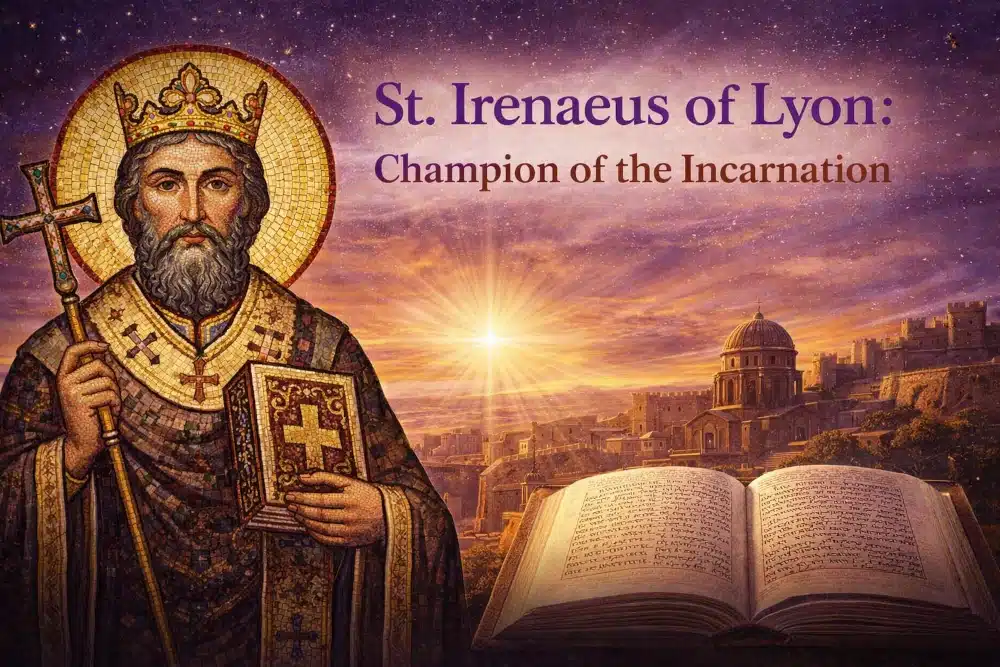
One of the most arresting lines in early Christian theology comes from St. Irenaeus of Lyon: “The glory of God is a living man; and the life of man consists in beholding God.”
That sentence alone tells you why he still matters. Irenaeus did not preach a thin Christianity made of abstractions, secret codes, or elite spiritual insight. He preached a faith rooted in the flesh of Christ, in the public witness of the apostles, and in the breathtaking claim that God is not ashamed of what He made.
St. Irenaeus lived in the second century, somewhere around AD 130 to 200, in that remarkable window when the Church still breathed the air of the apostolic age. He was a student of Polycarp, and Polycarp had been a student of John the Apostle. That matters. A lot. It means Irenaeus was not inventing a later theory of Christianity. He stood close to the stream itself.
And he used that closeness for battle. The Church of his day was facing the toxic miasma of Gnosticism, a swarm of teachings that treated matter as inferior, claimed salvation through hidden gnōsis, and offered counterfeit versions of Jesus dressed in biblical language. Irenaeus answered those claims with unusual force and clarity.
He became one of the Church’s great champions of the Incarnation, insisting that Christ does not save us by helping us escape our humanity, but by entering it. He defended the goodness of creation, the unity of Scripture, the Eucharist, and what he called the Rule of Faith—the apostolic pattern of truth handed down openly in the Church, not whispered to spiritual insiders.
He is also one of the clearest early voices on recapitulation, the stunning idea that Christ sums up all people in Himself, becoming the head of a new humanity and restoring what was lost through Adam.
That is why Irenaeus still feels fresh. He speaks into old heresies and modern ones too. He reminds us that the Christian faith is earthy, sacramental, historical, and gloriously alive.
St. Irenaeus was born around AD 130, most likely in Smyrna, in what is now Turkey. He grew up in a world where Christianity was still young, still vulnerable, and still marked by the living memory of those who had known the apostles or had learned directly from them.
That setting shaped everything.
As a young man, Irenaeus heard the preaching of Polycarp, the bishop of Smyrna. Polycarp had been formed by John the Apostle. So for Irenaeus, Christianity was never a system of spiritual speculation. It was a received inheritance. A living tradition. A faith transmitted through real people, real teaching, real churches, and real continuity.
That apostolic connection would become one of the great strengths of his later theology. He did not defend Christianity as one theory among many. He defended it as the public truth handed down from the apostles themselves.
At some point, Irenaeus traveled west to Gaul and became part of the Christian community in Lyon, in modern-day France. There he served under the local bishop and eventually succeeded him as bishop of Lyon. It was not an easy assignment. The Church in that region faced persecution, instability, and pressure from both outside enemies and internal doctrinal confusion.
Irenaeus appears to have served as bishop for more than twenty years. He was Greek-speaking, intellectually formidable, and pastorally grounded. He was not a cold academic. He was a shepherd defending his people from dangerous errors while helping them endure a hostile world.
His major surviving works are Adversus Haereses, usually called Against Heresies, and the Demonstration of the Apostolic Preaching. These works show both his theological precision and his deep commitment to the Church’s apostolic tradition.
Tradition places his death around AD 200, and some accounts suggest he may have died as a martyr. Whether or not that final detail can be proven with total certainty, his witness carried tremendous weight in the centuries that followed.
He stood near the beginning. And that is part of what makes him so powerful.
The great theological enemy in Irenaeus’s world was Gnosticism. That term covers a range of false teachings, but their family resemblance is easy to see. Matter was often treated as evil or at least inferior. The Creator God was separated from the highest divine reality. Salvation came through hidden knowledge—gnōsis—accessible only to a spiritual elite. And Jesus was reduced to a revealer of secrets rather than the incarnate Son who truly entered human history for our salvation.
Irenaeus saw the danger immediately.
If the material world is evil, then the Incarnation becomes absurd. Why would the Son of God take on flesh if flesh were beneath Him? Why would salvation come through the Cross, the Resurrection, and the sacraments if matter were something to escape rather than redeem?
His answer came in the form of one of the most important works in early Christian theology: Adversus Haereses, or Against Heresies. Its longer title is even sharper: Refutation and Overthrow of Knowledge Falsely So Called. That title tells you something about Irenaeus. He did not treat heresy as a harmless alternative perspective. He knew false teaching damages souls.
One of his most vivid analogies is the image of the mosaic of a king. Imagine a mosaic carefully arranged to depict a king. A deceiver dismantles the stones, rearranges them into the picture of a dog, and then claims the new image is the real one. The pieces are authentic. The arrangement is false. That, Irenaeus argues, is what heretics do with Scripture. They quote real verses. They use biblical names. They borrow holy words. But they twist the pattern and destroy the meaning.
This is why he insisted on the Rule of Faith. The Christian faith is not something each teacher may reinvent. It is received in the Church, proclaimed openly, and measured by apostolic continuity. Irenaeus points again and again to the succession of bishops and the public teaching of the Church as safeguards against novelty and distortion.
That does not mean he trusted structures instead of truth. It means he understood that truth had a visible home. Christianity is not a secret movement. It is not reserved for spiritual insiders. It is announced publicly, believed corporately, and guarded faithfully.
He also took aim at the fascination with so-called Lost Gospels and hidden revelatory systems that promised deeper insight than the common faith of the Church. For Irenaeus, the problem was not merely that these writings were extra. It was that they undermined the Gospel itself by replacing Christ crucified and risen with a mystic codebook for the enlightened.
And honestly, this still lands. Modern culture is packed with recycled versions of the same old temptation. You see it whenever spirituality turns inward and talks about the “God within” while quietly dismissing the Church, grace, repentance, revelation, and the bodily resurrection. Old heresies rarely die. They get rebranded.
Irenaeus remains a remarkably effective guide because he does not merely refute error. He offers a bigger, richer, truer vision of Christianity—one rooted in Christ, creation, sacrament, and apostolic truth.
If you want the beating heart of Irenaeus’s theology, here it is: Recapitulation.
The Greek term is Anakephalaiōsis, usually translated as “summing up” or “bringing together under one head.” For Irenaeus, Jesus Christ is not simply an isolated Savior performing a detached rescue. He is the new Adam, the one who gathers humanity back into right order by living a fully human life in obedience to the Father.
Where Adam failed, Christ succeeds. Where humanity fell into corruption, Christ brings healing. Where the first man opened the door to death, Christ opens the way to life.
This is why Irenaeus is rightly called a Champion of the Incarnation. He does not present salvation as a spiritual jailbreak from bodily existence. He presents it as the restoration of humanity through the flesh of Christ. Jesus enters the whole human condition—birth, growth, suffering, death—so that the whole human condition may be healed.
That is an intensely Earthy Gospel. The Creating God is not embarrassed by creation. He does not abandon what He made. He redeems it. The same God who formed man from the dust is the God who saves man through the Incarnate Son.
For Irenaeus, this is not a decorative detail. It is essential. If salvation does not touch the body, then it does not touch the human person. If Christ does not assume our humanity, then our humanity is not healed. But because He does assume it, our life can be renewed from the inside out.
This theology also shapes the way Irenaeus thinks about the Eucharist, the Lord’s Supper. The Eucharist is not a mere symbol of escape from the material order. It is proof that the material order can be taken up into grace. Bread and wine become instruments of divine life. The believer is nourished through real, created things. Matter is not the enemy. Matter can be sanctified.
That is why Irenaeus uses language of life and renewal. Christ does not merely instruct. He vivifies. He makes alive. He restores man to communion with God. He makes possible the vision hinted at in that famous line about the glory of God and man fully alive.
Recapitulation also gives Irenaeus a sweeping view of history. Christ is the Head of a new humanity. The human story is not random drift. It is moving toward fulfillment. What begins in the Incarnation, Cross, Resurrection, and sacramental life of the Church moves toward the final restoration of all things at the Eschaton.
This is one reason Irenaeus still feels so strong on the page. He sees Christianity as cosmic without becoming vague, sacramental without becoming sentimental, and theological without becoming detached from real human life.
The influence of St. Irenaeus is hard to overstate.
He helped the Church articulate what orthodox Christianity looks like when faced with clever distortions. He defended the unity of Scripture. He insisted on the continuity of apostolic tradition. He taught that the Father of Jesus Christ is the Creator of the world. He upheld the reality of the flesh. He tied doctrine to the life of the Church rather than to speculative mysticism.
That combination gave later theology a stable foundation.
Irenaeus also matters because of what he refused to do. He did not reduce Christianity to private spirituality. He did not turn salvation into a merely mental act. He did not flatten the Gospel into moral advice. His theology is thick with creation, redemption, Eucharist, Church, Scripture, and hope.
For generations, theologians, bishops, catechists, and seminary professors have returned to him for exactly that reason. He offers a robust, non-fragile Christianity—one big enough to account for doctrine, sacrament, history, and holiness all at once.
His thought has remained important in both ancient and modern theological study. Seminary classrooms have wrestled with him for decades. Patristics scholars continue to mine his work. Recent articles and renewed attention to his theology show that he has not faded into a museum case. He still speaks.
The Church’s formal recognition of his importance came in a particularly meaningful way when he was named a Doctor of the Church. That title fits him well. He was not only a defender of truth, but a teacher of unity—a man whose theological clarity helped bind the Church more deeply to her apostolic roots.
And maybe that is part of why he feels so needed now. In a fractured age, Irenaeus reminds us that truth is not created by private insight. It is received, confessed, guarded, and lived.
St. Irenaeus is not important merely because he is ancient. He is important because he answers problems that have never really gone away.
We still live in a culture tempted to divide spirit from body, inner self from created reality, private feeling from public truth. We still see versions of the same old Gnostic reflex—matter treated as disposable, doctrine treated as oppressive, the Church treated as unnecessary, and salvation reduced to a kind of internal awakening.
Irenaeus cuts through all of that with breathtaking simplicity.
The Christian faith is not an escape from creation. It is the redemption of creation through Jesus Christ. The body matters. History matters. The sacraments matter. Apostolic tradition matters. The Church matters. And Christ matters not as a code-breaker of hidden wisdom, but as the Word made flesh.
That is why his famous line still echoes so powerfully: “The glory of God is a living man; and the life of man consists in beholding God.” The Christian vocation is not to become less human. It is to become fully alive in Christ.
That vision is both bracing and beautiful. It reminds us that holiness is not disembodied. Grace does not erase creation. Redemption is not a denial of human life, but its healing and fulfillment.
So yes, read Irenaeus. Read Against Heresies. Read the Demonstration of the Apostolic Preaching. Sit with his vision of Christ as the one who sums up all people in Himself. Let his theology steady your imagination in a time of noise and confusion.
Because the answer he gave then is still the answer now: Jesus Christ is the head of a new humanity, and in Him man becomes fully alive.
This article draws from the witness of the early Church, especially the writings of St. Irenaeus of Lyon, one of the most important Christian voices of the second century. As bishop of Lyon and a hearer of St. Polycarp, who himself was formed by the apostolic age, Irenaeus stands close to the sources of historic Christianity. His work Against Heresies remains one of the clearest early defences of the Incarnation, the goodness of creation, apostolic tradition, and the public faith of the Church.
This summary is written for catechetical and educational use, aiming to present Church history in clear, faithful language while remaining accessible to modern readers. It is not a substitute for reading Irenaeus directly, but it is meant to point readers back to the Fathers, to Scripture, and to the living tradition of the Church.
St. Irenaeus of Lyon was a second-century bishop, theologian, and early Church Father. He was born in Asia Minor, likely heard the teaching of Polycarp, and later served the Church in Lyon, where he became one of Christianity’s strongest defenders against heresy.
He helped preserve orthodox Christianity at a time when false teachings were spreading fast. His writings defended apostolic tradition, the unity of Scripture, the goodness of creation, and the truth that Jesus Christ truly came in the flesh.
Irenaeus rejected Gnosticism because it treated matter as evil, salvation as secret knowledge, and Christian revelation as something hidden from ordinary believers. He answered that the faith was publicly handed down through the apostles and guarded in the Church.
Recapitulation means that Christ “sums up” all things in Himself. As the new Adam, Jesus enters human life in order to restore, heal, and renew what was damaged by sin. It is one of Irenaeus’s central ideas.
It means human life reaches its true fullness not apart from God, but in communion with Him. Irenaeus ties this line to the vision of God, showing that humanity becomes fully alive when restored through Christ.
Yes. Pope Francis declared St. Irenaeus a Doctor of the Church in 2022 and gave him the title “Doctor of Unity,” recognizing both his theological importance and his bridge-like role between East and West.