
From the Paschal Candle to Divine Mercy Sunday, the season proclaims one truth: Christ the Light defeats death, and mercy is now on the loose.
“If Christ has not been raised, then our preaching is in vain and your faith is in vain” (1 Cor 15:14). That’s not polite religious language. That’s a spine-and-heart claim. Everything stands or falls on the Lord’s resurrection.
Easter is the Church’s central celebration of Christ’s victory over death. Even the old-language echoes fit: the Old English “East” points toward the rising sun—light, warmth, hope—an image that quietly preaches Christ the Light. Not a seasonal vibe. A cosmic reversal.
Easter Sunday launches the most important stretch of our liturgical times: Easter Season, celebrated for 50 days, from Easter Sunday to Pentecost. It’s one long Alleluia—like the Church refuses to whisper when heaven has just shouted.
Worship isn’t “extra” during Easter. It’s the point. Join the parish. Bring your family. Bring your questions too.
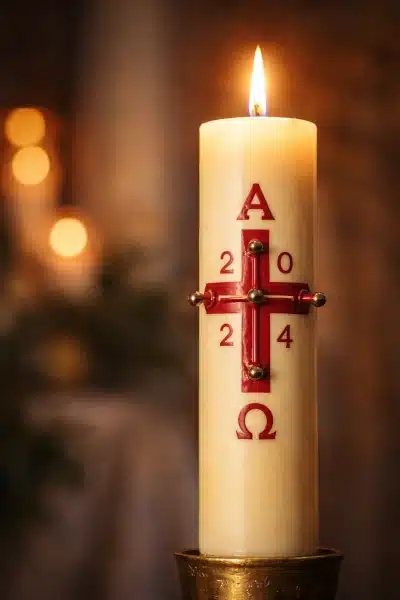
The Church doesn’t “explain Easter” first. She shows it. The Paschal Candle takes center stage—lit at the Easter Vigil, then carried into the season like a living proclamation: Christ the Light is not a metaphor. He’s alive.
The Easter Vigil is called the Mother of All Vigils for a reason. The fire. The dark. The slow spread of flame. And then the Exsultet—the Proclamation of Easter—sings the world awake: “Be glad, let earth be glad…” That’s not decoration. That’s worship doing what worship does: naming what’s real.
Scripture gives the deep logic of the Resurrection. St. Paul uses seed imagery in 1 Cor 15:36–49: what dies is raised, what is corruptible becomes incorruptible. Easter is not resuscitation. It’s transformation.
Here’s the part many people miss: Easter isn’t a single day with leftovers. The octave of Easter runs eight days—from Easter Sunday through the Second Sunday of Easter—like the Church refuses to let joy collapse into routine.
Then the season keeps going. The full 50 days of Easter stretch to Pentecost. These Sundays are counted as “Sundays of Easter.” The Alleluia stays. The readings keep hammering one theme: the risen Christ is building His Church in real time.
Easter joy deepens when it’s practiced. Come for the Octave. Stay through Pentecost. Let the season do its work.
The Second Sunday of Easter is Divine Mercy Sunday, the Feast of Mercy. In 1931, Jesus’ apparitions to Sr. Faustina pressed one message into the heart of the Church: mercy is not an optional devotion. It’s the Resurrection applied.
The image says it plainly: “Jesus, I trust in You.” Trust is not a mood. It’s an act—especially when life is messy and conscience is loud. And yes, Divine Mercy has a devotional rhythm: the Chaplet of Divine Mercy, prayed especially at the hour of great mercy (3:00 p.m.).
The Church also attaches a plenary indulgence to this feast under the usual conditions: Confession, Eucharist, prayer for the Pope’s intentions, and detachment from sin. Not a loophole. A rescue.
The Ascension isn’t Jesus “leaving.” It’s Jesus reigning. Acts says He is taken up (Acts 1:9), and the disciples are reminded He will come again (Acts 1:11). The risen Lord carries our humanity into heaven—and that changes how Christians talk about destiny.
The Catechism (CCC 665–667) speaks of Christ’s exaltation and His ongoing intercession. In other words: He precedes us, He prays for us, and He promises the Holy Spirit.
Note: In many places the Ascension is observed on the Seventh Sunday of Easter; in others it remains Thursday. (Local diocesan calendars settle the practical date.)
On the 50th day, the Church celebrates the Solemnity of Pentecost. The Holy Spirit descends on the disciples and flips everything: fear becomes proclamation, hiding becomes mission, and the Church steps into the world with a voice.
Pentecost also has Jewish roots in Shavuot (Feast of Weeks), associated with the giving of the Law. Now the Spirit writes the law within—on hearts, not stone. That’s the point.
Liturgically, some places observe an extended vigil with Old Testament readings. And after Pentecost Mass, the Paschal Candle—so central through the season—is typically extinguished. Not because Christ’s light is gone. But because it’s meant to burn in His people.
Holy Spirit, come. Don’t just comfort—convert. Don’t just inspire—strengthen. Make ordinary Catholics dangerous to darkness.
Easter Season has a “feel” that’s hard to fake: Alleluias return, resurrection themes dominate the readings, and the Church prays like someone who has seen the empty tomb and decided to live accordingly.
Practically: show up. Pray with the daily readings. Make room for confession. Add one simple devotion (Divine Mercy Chaplet is a solid choice). And if the soul has been dragging… Easter is the season to start again without drama. Quiet fidelity beats spiritual mood swings. Every time.
Easter is the Church’s refusal to accept a small life. The Resurrection stands at the center. Divine Mercy answers the wounded. The Ascension lifts our eyes. Pentecost puts fire in the bones.
In a world that talks like God is optional—an “eclipse of God” kind of age—Easter teaches the opposite: Christ is risen. And reality belongs to Him.
Alleluia.
Accuracy: This page follows Catholic teaching on Easter Season, the Paschal Mystery, the Ascension, and Pentecost, with Scripture and Catechism grounding.
Pastoral focus: Easter is meant to be lived—through worship, confession, prayer, and real conversion (not just one “inspiring weekend”).
Local connection: Published for San Isidro Catholic Church, Fayetteville, NC — 4733 Macedonia Church Road. Phone: (910) 424-2698.
Sources: USCCB — Easter Time norms · USCCB — Ascension note · Universal Norms (public text)
Easter is the central feast celebrating the Lord’s resurrection—Christ’s victory over sin and death, and the foundation of Christian faith.
Because it’s the Church’s primary night of worship: Scripture, fire, the Paschal Candle, and the Proclamation of Easter (Exsultet) announce the Resurrection with full intensity.
The Paschal Candle is a central Easter symbol of Christ the Light—lit at the Easter Vigil and used through the season to signify the risen Lord’s presence and victory.
Easter Time lasts 50 days—from Easter Sunday to Pentecost. The first eight days are the Octave of Easter, celebrated as an extended solemn joy.
Divine Mercy Sunday is the Second Sunday of Easter, emphasizing mercy flowing from the Resurrection. Catholics often pray the Chaplet of Divine Mercy and honor the image with the prayer “Jesus, I trust in You.”
It’s a traditional time associated with recalling Christ’s death and asking for mercy—often connected with praying the Divine Mercy Chaplet at 3:00 p.m.
The risen Jesus ascends and precedes us into heaven, interceding for us and preparing the Church for the coming of the Holy Spirit (Acts 1; CCC 665–667).
Pentecost is the 50th day when the Holy Spirit descends on the disciples, transforming fear into mission and sending the Church into the world with power.