
A Private Mass is celebrated by a priest without a congregation present. Even without a public assembly, the Mass is offered for the Church and the world and carries the same Eucharistic value.
Before Vatican II, the Private Mass (or Missa Privata) was more common — a Mass celebrated by a priest without the presence of a congregation. It was not “private” in the modern sense of secrecy, but in the sense that the priest celebrated it alone, sometimes with only an altar server assisting. The focus was on the priest’s sacrificial offering, uniting with Christ in prayer for the Church and the world.
After Vatican II, the Church emphasized the communal nature of the Eucharist, encouraging active participation by the faithful. However, Private Masses are still celebrated today, especially in monasteries or by priests offering Mass intentions for specific souls or needs. Even without a congregation, the priest acts in persona Christi — in the person of Christ — making the sacrifice of the Mass on behalf of all the faithful. It remains a powerful reminder that every Mass, public or private, carries infinite value before God.
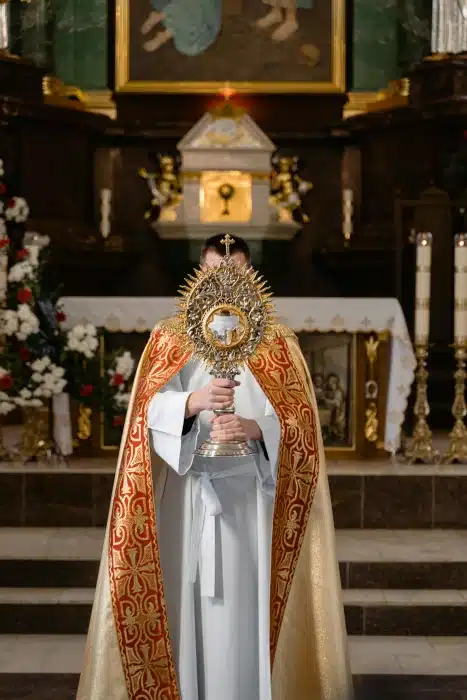
The Parochial Mass is what most Catholics experience week after week. It’s the regular Mass celebrated in local parishes — the living pulse of the Church’s community life. Here, the faithful come together not as spectators but as participants in a shared act of worship. Families, students, and elders gather to hear the Word of God, receive the Eucharist, and renew their commitment to Christ.
This Mass embodies the Church’s identity as a people, not just an institution. It reflects what the Second Vatican Council emphasized: the Mass is not a private devotion but a communal celebration. In a parochial setting, parishioners are reminded that they are part of something greater than themselves — a universal Church, yet rooted in a particular neighborhood. The Parochial Mass thus becomes the heartbeat of the local Church, binding people through faith, fellowship, and service.
A Conventual Mass is celebrated regularly within a religious community, such as a monastery or convent. Members of the community gather to pray the Mass as part of their daily rhythm of communal prayer and worship.
In monasteries, abbeys, and convents, the Conventual Mass holds a special place in daily life. It is celebrated by and for the religious community — monks, nuns, or friars — as part of their common spiritual rhythm. Unlike a parochial Mass centered on a local congregation, the Conventual Mass is intimately tied to the Liturgy of the Hours, forming a seamless day of prayer and work (ora et labora).
This Mass reinforces the bonds within a religious house, reminding its members that their shared mission flows from the Eucharist. The quiet solemnity of a Conventual Mass, often enriched by Gregorian chant, invites deep reflection. It’s not about external display but about interior communion. Each member participates in offering the Mass for the Church, the world, and their specific apostolate.
A Votive Mass is celebrated for a specific purpose or devotion, outside the cycle of Sundays and solemn feast days. The word “votive” comes from votum, meaning “vow” or “intention.” These Masses allow priests and communities to offer the Eucharist for particular needs or devotions — for example, a Mass of the Holy Spirit, a Requiem Mass for the deceased, or a Nuptial Mass for newlyweds.
The beauty of the Votive Mass lies in its adaptability. It reflects the Church’s pastoral care, responding to the diverse intentions of the faithful — thanksgiving, petition, intercession, or remembrance. Whether it’s a Mass of Supplication during a national crisis or a Mass of Thanksgiving for blessings received, the structure remains the same, but the prayers and readings are chosen to express the specific intention. This flexibility reminds us that the Eucharist is not confined to rigid ritual but breathes with the life of the Church and her people.
The main types of Catholic Mass include Parochial, Private, Conventual, Votive, Requiem, Nuptial, Mass of Thanksgiving, Mass of Supplication, Vigil, Pontifical, Concelebrated, High Mass, Low Mass, and Solemn Mass. Each serves a specific purpose in the Church’s liturgical life.
A Requiem Mass is celebrated for the deceased. Its prayers ask God to grant eternal rest and mercy to those who have died, while also affirming Christian hope in the resurrection of the dead.
Few liturgies are as moving as the Requiem Mass, celebrated for the souls of the deceased. Named after the Latin word requiem (“rest”), this Mass begins with the ancient introit, Requiem aeternam dona eis, Domine — “Eternal rest grant unto them, O Lord.” Its purpose is to pray for the repose of souls, offering them to God’s mercy and hope of resurrection.
Traditionally, Requiem Masses were marked by black vestments, somber chant, and the haunting sequence Dies Irae (“Day of Wrath”), evoking both divine justice and compassion. Today, after Vatican II, the tone has shifted toward hope — white or violet vestments often replace black, emphasizing the promise of eternal life. Yet, the essence remains: love expressed through prayer for those who have gone before us.
The Requiem Mass reflects the Church’s profound belief in the Communion of Saints — that death does not sever the bonds of faith and charity between the living and the dead. It teaches that remembrance is an act of love, and that the Eucharist remains the bridge between time and eternity.
The Nuptial Mass celebrates not just a wedding but a sacrament — a covenant between a man, a woman, and God. Within the Catholic Church, marriage is elevated by the Eucharist, which strengthens the couple’s union with divine grace. The exchange of vows, the blessing of rings, and the Nuptial Blessing are all woven into the liturgy.
The prayers of the Nuptial Mass invoke God’s blessing upon the couple’s journey: for unity, fidelity, and openness to life. The readings often highlight love’s divine origin, from Genesis’ creation of man and woman to St. Paul’s vision of marriage as a reflection of Christ’s love for the Church. By receiving the Eucharist together, the couple begins their married life rooted in Christ — a union not only of hearts but of souls.
A Mass of Thanksgiving is the Church’s way of sanctifying moments of gratitude. These Masses are celebrated for special blessings — the recovery of health, the conclusion of a fruitful mission, or milestones like anniversaries or dedications. They remind the faithful that gratitude is more than an emotion; it is an act of worship.
Throughout history, great leaders have called for Masses of Thanksgiving to mark moments of peace, victory, or deliverance. For example, after wars or during national renewal, communities have gathered around the altar to give thanks to God. On a personal level, many Catholics request such Masses after surviving illness, achieving an important goal, or receiving an answered prayer. Gratitude finds its most perfect expression in the Eucharist itself — the word “Eucharist” literally means “thanksgiving.”
When the Church or her members face trial, the Mass of Supplication becomes a powerful spiritual response. These Masses are offered in times of illness, drought, war, or any deep distress — moments when humanity cries out for divine mercy. They echo the ancient biblical practice of lament and intercession, transforming suffering into trust.
The prayers of a Mass of Supplication often invoke the saints or particular aspects of God’s mercy: Christ the Healer, Mary the Comforter, or the Holy Spirit as Advocate. Through these liturgies, believers find strength, solidarity, and peace. Even when outcomes remain uncertain, the act of supplication unites suffering with the Cross, reminding us that faith does not erase pain but redeems it.
The Vigil Mass is celebrated on the eve of major feasts or solemnities — a tradition rooted in ancient Christian practice. The idea of keeping vigil through the night, watching and praying, reflects Jesus’ call: “Watch and pray, for you do not know the hour.”
Today, the Vigil Mass often takes place the evening before Sunday or a holy day of obligation, allowing the faithful to begin their observance early. The Easter Vigil is the most magnificent example, marking the Resurrection with readings, psalms, and the lighting of the Paschal candle. In both Roman and Eastern Catholic Churches, vigil celebrations hold profound symbolic value — the Church waiting in joyful expectation for God’s promise to be fulfilled.
The Pontifical Mass is celebrated by a bishop, often in his cathedral, surrounded by deacons, priests, and servers. This form of the Mass emphasizes the bishop’s role as shepherd and successor of the apostles. His presence signifies unity with the universal Church and the Pope.
Rich in ceremony, a Pontifical Mass may include the bishop’s blessing with the crosier, the use of incense, and the participation of a large choir. It’s not about grandeur for its own sake but a visible sign of the Church’s hierarchical and sacramental nature. When a bishop celebrates Mass, it reminds the faithful that the Church is one body, united under Christ the Head and guided by apostolic authority.
A Concelebrated Mass involves several priests celebrating together, each sharing in the Eucharistic sacrifice. This practice, encouraged by Vatican II, reflects the unity of the priesthood and the collegial spirit of the Church. Concelebration is common during ordinations, major feasts, and diocesan gatherings. It highlights that the Eucharist is not a private possession but a shared mystery. Each priest joins in the same act of offering, symbolizing the universal nature of Christ’s priesthood. For the faithful, seeing multiple priests concelebrating is a visible reminder that the Church’s ministry is collective — many voices, one sacrifice.
↑ Back to top
In the traditional Latin liturgy, distinctions exist between the High Mass (Missa Solemnis) and Low Mass (Missa Lecta). A High Mass is celebrated with greater solemnity — incense, singing, and a full choir accompany the prayers. The Low Mass, in contrast, is simpler, spoken rather than sung, and often without music.
These distinctions are not about superiority but about expression. The High Mass lifts the senses through sound and ceremony, evoking the majesty of heaven. The Low Mass, quieter and more reflective, invites interior prayer and contemplation. Both forms lead to the same mystery — Christ made present on the altar — yet offer different ways of encountering Him.
A Solemn Mass is the most elaborate form of the liturgy short of a Pontifical celebration. It includes deacon and subdeacon assistance, processions, incense, and chant. Every gesture and prayer has deep symbolism — the rising incense representing prayers ascending to heaven, the candles symbolizing Christ as the light of the world.
The Solemn Mass is not merely performance but proclamation: beauty in service of truth. It reminds worshippers that liturgy is the Church’s highest art form — the meeting of divine and human creativity. While not every Mass can be solemn, every Mass draws from the same sacred heart: the offering of Christ for the salvation of all.
The Catholic liturgical calendar orders the year with a sacred rhythm. Not all days hold equal rank; each has its own weight in celebrating the mysteries of salvation.
Sources
Chapter IV: The different forms of celebrating mass. USCCB. (n.d.-a).
Types of masses. Catholic Knowledge | Heritage History. (n.d.).
©San Isidro. All rights reserved.