Friar Placido Cortese
Reflection Snapshot
Servant of God Friar Placido Cortese (1907–1944), a priest of the Friars Minor Conventual (OFM Conv.), became one of the quiet heroes of the Second World War. Working from the Basilica of St. Anthony in Padua, he helped Jews, prisoners, and persecuted refugees escape Nazi persecution. Arrested by the Gestapo in 1944, he endured brutal torture but refused to reveal the names of others involved in the rescue network. His courage and sacrifice have led the Catholic Church to open his beatification cause as a martyr.
History often hides its greatest heroes in unexpected places. In the quiet confessional of the Basilica of St. Anthony in Padua, a Franciscan priest listened to confessions, offered spiritual guidance, and quietly helped coordinate rescue missions that saved lives during one of Europe’s darkest moments.
That priest was Friar Placido Cortese, now recognized as a Servant of God by the Catholic Church.
His story isn’t about military heroism or battlefield bravery. Instead, it’s about a humble Franciscan priest who believed the Gospel demanded action. When Nazi persecution tightened its grip across Europe during the Second World War, he answered that call with courage rooted in faith.
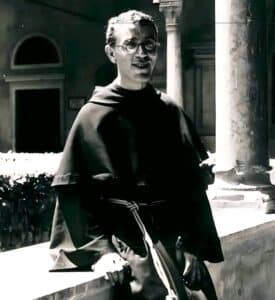
Early Life and Formation (1907–1931)
Formation Insight
Born Nicolò Matteo Cortese in Cres, Croatia, in 1907, he entered the Order of Friars Minor Conventual at a young age and took the name Friar Placido. His formation in Franciscan spirituality prepared him not only for priesthood—but for the extraordinary courage he would later demonstrate during the war.
Friar Placido Cortese was born Nicolò Matteo Cortese on March 7, 1907, in Cres, Croatia. At that time the island belonged to the Austro-Hungarian Empire. His early life unfolded in a small coastal community where the Franciscan presence shaped much of the local spiritual culture.
The Friars Minor Conventual serving at the Church of St. Francis had a profound influence on the young boy. Their example of prayer, humility, and service quietly planted the seeds of a religious vocation.
In 1920, Cortese entered the Order’s college in Camposampiero near Padua, Italy. It was here that his Franciscan formation truly began.
When he professed temporary vows on October 10, 1924, at the Friary of St. Anthony in Padua, he received the religious name Placido, meaning “peaceful.” The name suited him well. Those who knew him described a gentle personality, calm demeanor, and sincere kindness toward others.
His solemn vows followed on October 4, 1928, in the Basilica of St. Francis in Assisi, one of the most sacred places in the Franciscan world.
Placido studied philosophy in Cres between 1925 and 1927 before continuing theological studies in Rome at the Faculty of St. Bonaventure. Fellow students remembered him for modesty, friendliness, and a natural attentiveness to the needs of others.
On July 6, 1930, he was ordained a priest in Rome. At that point, his future seemed clear: a life of Franciscan ministry centered on preaching, pastoral care, and service.
But history was about to intervene.
Priestly Ministry (1931–1943)
Ministry Highlight
Before becoming known for wartime heroism, Friar Placido Cortese was respected as a pastor and communicator. His leadership of the Catholic publication Messaggero di Sant’Antonio helped expand its reach across Italy.
After ordination, Friar Placido’s first assignment brought him to the Basilica of St. Anthony in Padua, one of the most important pilgrimage sites in Europe. From 1931 to 1933 he served there as a young Franciscan priest, assisting pilgrims and contributing to the spiritual life of the friary.
In 1933 he was transferred to Milan, where he served as assistant pastor at the Church of Beata Vergine Immacolata e Sant’Antonio. Parishioners quickly noticed his gentle pastoral style. He listened carefully, spoke simply, and treated every person with genuine respect.
Then, in 1937, a new opportunity emerged.
Friar Placido was appointed director of the Catholic magazine Messaggero di Sant’Antonio. The publication was already well known among Italian Catholics, but under his leadership it grew significantly. In 1939 a new printing house was inaugurated, allowing the magazine to expand its circulation dramatically.
Within a few years, the readership doubled.
Yet those who worked with him said success never changed him. He remained humble, attentive, and deeply committed to Franciscan values.
But Europe was heading toward catastrophe. And the mission of Friar Placido was about to take an unexpected turn.
World War II Heroism (1942–1944)
Heroic Charity
During Nazi occupation, Friar Placido became involved in the underground FRA-MA network, which helped Jews, Allied soldiers, and refugees escape persecution and reach safety in Switzerland.
By 1942 the war had reached deep into Italy. Prison camps filled with detainees from Slovenia and Croatia, including many held at the Padua-Chiesanuova camp.
Friar Placido quietly began helping them. He provided aid, spiritual encouragement, and practical assistance whenever possible.
Then came a decisive moment in Italian history.
On September 8, 1943, Italy signed an armistice with the Allies. German forces quickly occupied northern Italy, and the situation became even more dangerous. Jews, escaped prisoners, and political dissidents suddenly found themselves hunted by Nazi authorities.
It was during this time that Friar Placido became a key figure in the FRA-MA rescue network, organized by professors Ezio Franceschini and Concetto Marchesi.
The network helped refugees escape through Italy and across the Swiss border.
And one of its most important contact points was the confessional inside the Basilica of St. Anthony.
There, hidden in plain sight, messages were exchanged. Contacts were arranged. Escape plans were coordinated.
Friar Placido never saw himself as a hero. His motivation came from Scripture. He often repeated the words of St. Paul:
Caritas Christi urget me — “The love of Christ urges us on.”
Those words guided everything he did.
Martyrdom and Death
Martyrdom Witness
Arrested by Nazi agents in 1944, Friar Placido Cortese was taken to the Gestapo headquarters in Trieste and tortured for information about the resistance network. He refused to betray anyone.
On October 8, 1944, around midday, Nazi SS agents arrived at the Basilica of St. Anthony in Padua.
They had discovered the rescue operations.
Friar Placido was arrested and transported to Gestapo headquarters in Trieste, located in Piazza Oberdan. There he was subjected to brutal interrogations. The Nazis demanded the names of collaborators connected to the FRA-MA network.
But he refused.
Despite torture and relentless pressure, Friar Placido did not reveal a single name.
Sometime in mid-November 1944, he was killed.
His body was cremated at the notorious Risiera di San Sabba prison, a Nazi detention and extermination facility.
Witnesses later described his sacrifice as a form of martyrdom. Some compared him to St. Maximilian Kolbe, another Franciscan who gave his life during the war.
Like Kolbe, Friar Placido chose fidelity to Christ over personal survival.
Beatification Cause and Honors
Path Toward Sainthood
The Catholic Church has opened the beatification cause of Friar Placido Cortese, recognizing the possibility that his death qualifies as martyrdom for the faith.
Decades after the war, the Church began formally examining his life.
A diocesan inquiry into his martyrdom opened in Trieste between 2002 and 2003. A second investigation into his heroic virtues followed in 2012.
The historical documentation for the cause, known as the Positio super virtutibus, was approved by historical consultors on January 31, 2017, and published in full the following year.
The process involves collaboration between Church authorities in Italy, Slovenia, and Croatia.
Civil recognition has also followed.
In 2017, Italian President Sergio Mattarella awarded Friar Placido Cortese the Gold Medal of Civil Merit, recognizing his courageous defense of the persecuted.
Three years later, Mattarella visited the Basilica of St. Anthony to honor the memorial confessional associated with Friar Placido’s resistance work.
Today, many Catholics view him as a modern witness to the Gospel—a Franciscan priest whose life embodied charity, courage, and solidarity during one of history’s darkest periods.
Historical Sources and Catholic Documentation
This article is based on historical records and ecclesial documentation concerning Servant of God Friar Placido Cortese, OFM Conv.
Primary reference material includes official Franciscan sources documenting his life, wartime activities, martyrdom, and the ongoing beatification cause within the Catholic Church.
Key sources include:
Order of Friars Minor Conventual
https://www.ofmconv.net/en/servo-di-dio-fra-placido-cortese-sacerdote-1907-1944/
Franciscan Voice
https://franciscanvoice.org/venerable-servant-of-god-placido-cortese/
These sources provide historical testimony regarding Friar Placido Cortese’s efforts to assist victims of Nazi persecution, his arrest by the Gestapo in Trieste, and the ongoing Church investigation into his martyrdom and heroic virtues.
His life continues to inspire Catholics as a witness of Gospel courage and Franciscan charity during the Second World War.